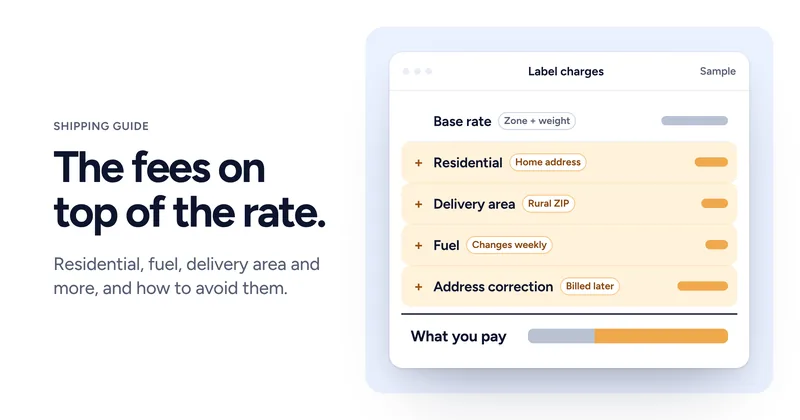
The price on a shipping label isn’t always the final price: adjustments and surcharges can arrive days after you ship, a label can be billed twice, and a late overnight package may be owed a refund nobody asks for. A shipping audit is how you catch those errors and get the money back. Here’s what to check, which late deliveries still earn a refund, how to file claims and a simple monthly routine.
What is a shipping audit?
A shipping audit, also called a parcel audit, is a line-by-line check of your shipping charges. For each package, you compare what you bought (the service, weight, box size, address and fees) with what the carrier or label platform billed. Anything that doesn’t match gets disputed, and anything you’re owed gets claimed.
Charges can also change after you ship. Carriers weigh and measure packages in their networks and bill any difference from the label. USPS does this with Automated Package Verification, which checks the weight, dimensions and shipping zone on the label and charges adjustments through the platform that sold it. UPS calls its version a shipping charge correction.
An audit recovers three kinds of money:
- Billing errors and overcharges: charges that are wrong or shouldn’t be there at all.
- Carrier refunds: shipping charges returned when a guaranteed service arrives late.
- Claims: payment for packages that were lost or arrived damaged.
Labels bought on your own UPS or FedEx account are billed on the carrier’s invoice. Labels bought through a label platform show up in its transaction history, along with any adjustments.
Shipping overcharges and billing errors to look for
The billing errors worth checking fall into seven groups. The first three show up in the original charges; the rest often arrive later as adjustments.
Duplicate charges
Look for the same tracking number billed twice, or two labels bought for one order after a failed print. Sort your charges by tracking and order number and repeats stand out. Dispute double charges and void any extra label.
Labels you bought but never used
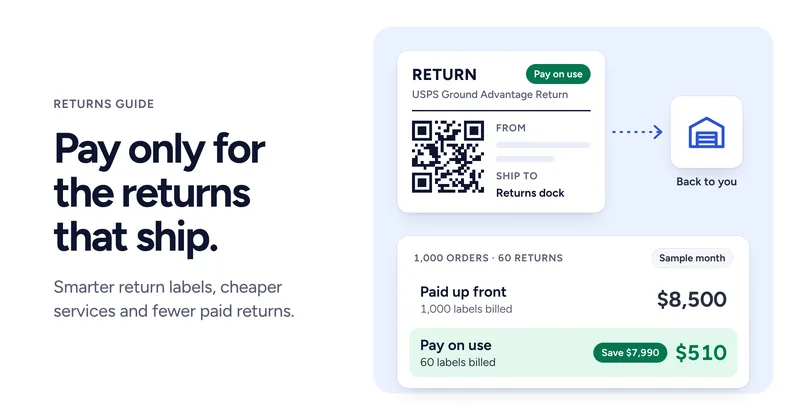
Canceled orders and misprints are easy to forget, and an unused label is money spent until you void it. For USPS postage bought through a label platform, request the refund through that platform within 30 days of printing. USPS Click-N-Ship takes requests from your shipping history for 30 days, or through its help desk for up to 60.
UPS lets you void a label yourself within 90 days on its own shipping tools, as long as UPS doesn’t have the package. Once a refund is approved, destroy the label so nobody ships with it by mistake.
The wrong service billed
Compare the service on each charge with the one you picked. If you bought a ground service and were billed for an air service, or your negotiated discount wasn’t applied, that’s a billing error to dispute.
Weight and dimension adjustments
If the carrier’s scale or scanner finds a heavier or bigger package than you entered, it bills you again at the higher billable weight (the greater of actual and dimensional weight). Check each adjustment against the weight and box you recorded. Fractions count, because carriers round up, as our guide to dimensional weight explains.
Many adjustments are correct, and the fix is better data at the packing table. Dispute the rest: a box you know you weighed correctly, or dimensions that match no box you stock.
Photograph the boxes that keep getting adjusted
If a product keeps getting adjusted, photograph the sealed box on the scale and next to a tape measure before it ships. That photo is your evidence when an adjustment is wrong.
Residential vs. commercial misclassification
UPS and FedEx add a residential surcharge to home deliveries, and UPS counts a home-based business as residential. If you mark a home address as commercial, the carrier reclassifies it and bills the surcharge later as an adjustment. The reverse happens too: a residential fee on an office, store or warehouse. Dispute those with the business name and address.
Address correction fees
When an address is wrong or incomplete, the carrier can find the right one, deliver there and charge an address correction fee. Validating addresses as orders come in prevents many of these. Dispute any fee on an address that was already complete and correct.
Surcharges that don’t apply
Delivery area, additional handling and oversize fees each have published triggers, such as a list of ZIP codes, a size or weight limit, or an item not fully enclosed in a corrugated box. If a fee appears and the package doesn’t meet the trigger, dispute it. Our guide to carrier surcharges explains what sets off each one.
Late-delivery refunds: which services still have a money-back guarantee?
Some express services come with a money-back guarantee: if the carrier doesn’t deliver, or attempt delivery, by the guaranteed time, you can ask for the shipping charges back. UPS and FedEx suspended their guarantees in March 2020 and have since brought them back for some services only.
| Carrier | Guarantee in effect | Suspended or not offered | Request deadline |
|---|---|---|---|
| UPS | Next Day Air Early, Next Day Air, Next Day Air Saver, 2nd Day Air A.M. | Other services, including 2nd Day Air, 3 Day Select and Ground | 15 calendar days after the scheduled delivery date |
| FedEx | First Overnight, Priority Overnight, Standard Overnight, 2Day A.M. | Other services, including Ground, Home Delivery, Express Saver and 2Day | 15 calendar days from the invoice date (ship date if you paid by card) |
| USPS | Priority Mail Express | Priority Mail and USPS Ground Advantage (no guarantee) | 2–30 days after the mailing date (without extra services) |
Every guarantee has exceptions, such as peak holiday periods, so check the current service guide before you file. To request a refund, have the tracking number, ship date, package weight and recipient’s name and address ready. Refunds go to whoever paid for the shipment, so for a label bought through a platform, ask the platform how to file.
How to file a lost package claim or damage claim
A claim asks the carrier to pay for the goods, not to fix the shipping charge, and what you can recover depends on the package’s coverage.
Declared value and insurance basics
As of October 2026, UPS and FedEx limit their liability to $100 per package unless you declare, and pay for, a higher value. USPS Priority Mail, Priority Mail Express and USPS Ground Advantage include up to $100 of insurance, and you can buy more. Either way it’s a cap, not a payout: you still have to prove what the item was worth.
What to document
- The tracking number, ship date and a copy of the label.
- Proof of value, such as the order or your purchase invoice.
- Photos of the outer box, the packing and the damaged item, taken before anything is thrown away.
- The original box and contents, kept until the claim is settled.
When to file
| Carrier | Damaged or missing contents | Lost package |
|---|---|---|
| UPS | Notify UPS within 60 days of delivery; written claim within 9 months | Notify UPS within 60 days of the scheduled delivery date; written claim within 9 months |
| FedEx | Within 60 calendar days of the ship date | Within 9 months of the ship date |
| USPS | Within 60 days of the mailing date | 15–60 days after the mailing date (Priority Mail and USPS Ground Advantage) |
File early, and keep the box
These are outside limits, so file as soon as you know something’s wrong. Ask the customer to keep a damaged box until you have photos; FedEx asks you to keep the original packaging and contents until the claim is resolved.
A monthly shipping audit routine, step by step
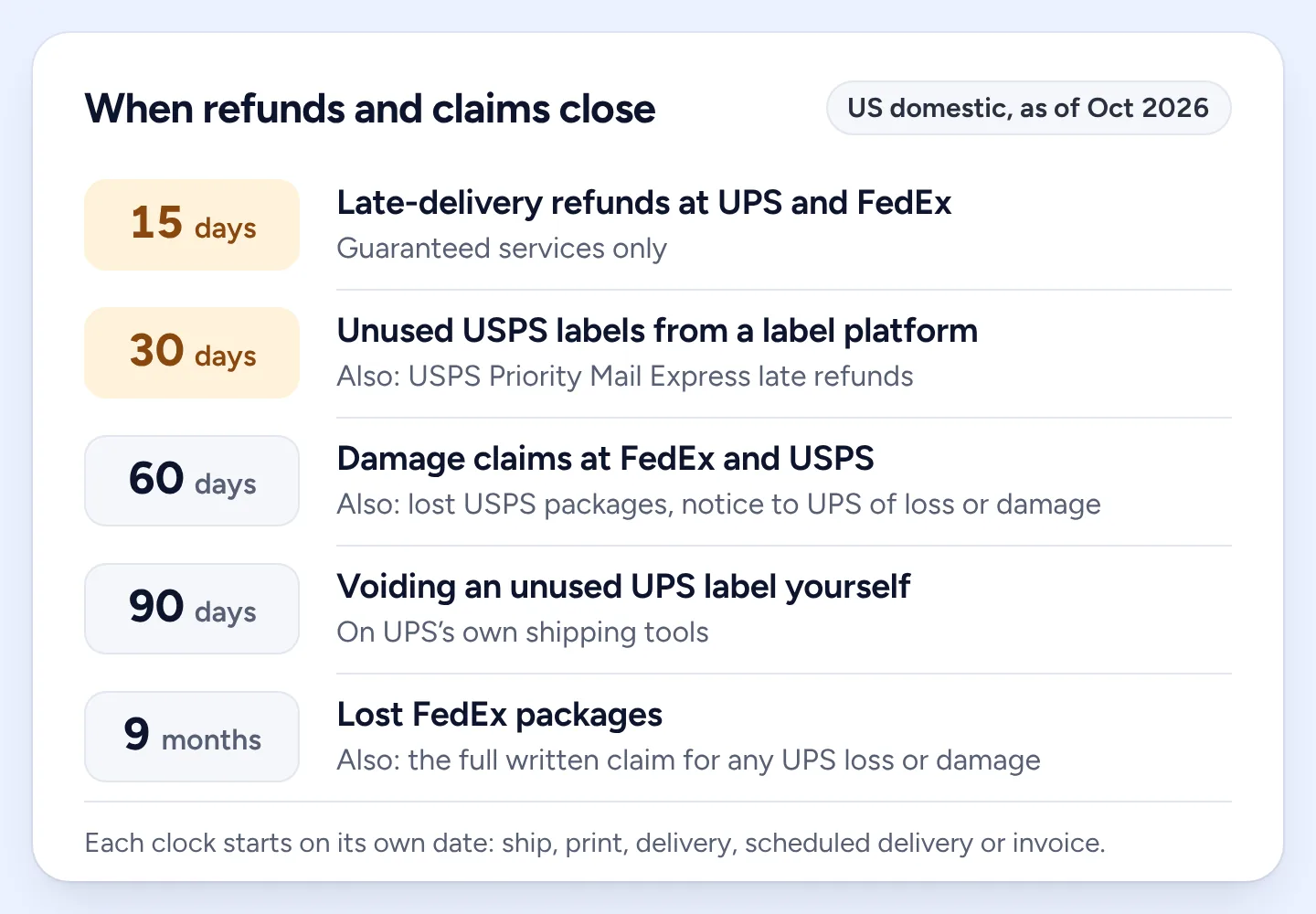
Deadlines are the reason to audit monthly. A yearly review finds errors long after most windows have closed. A monthly one catches most of them in time, with two exceptions: late-delivery refunds at UPS and FedEx close after 15 calendar days, and unused USPS labels from a label platform must be refunded within 30 days of printing. So check guaranteed overnight shipments every week, and void unused labels as soon as an order is canceled.
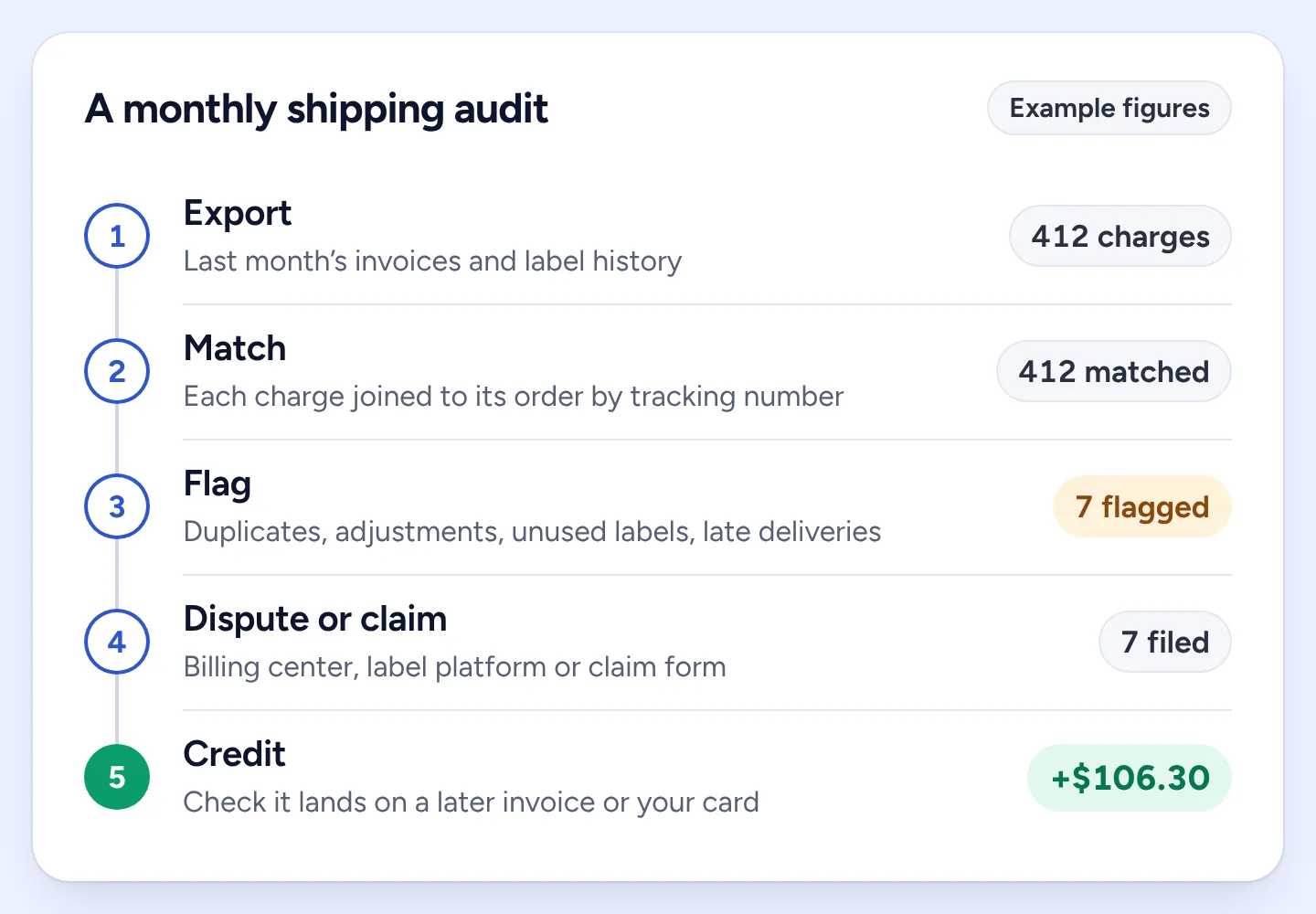
The routine itself has five steps:
- Export your charges. Download last month’s carrier invoices and each label platform’s transaction history, adjustments included.
- Match them to your shipments. Join each charge to its order by tracking number, so what you shipped (service, weight, box, address type) sits next to what you were billed.
- Flag the exceptions. Mark repeats, adjustments, unexpected surcharges, service mismatches, unused labels and late deliveries on guaranteed services.
- Dispute and claim. File billing disputes in the carrier’s billing center or with the platform, request late-delivery refunds, and file lost and damaged claims with your evidence.
- Track the credits. Note what you filed and when, check that credits arrive, and follow up on anything still open.
Then fix the cause: re-measure any box that keeps getting adjusted and update the weight and size saved in your store or shipping software.
What one month can recover
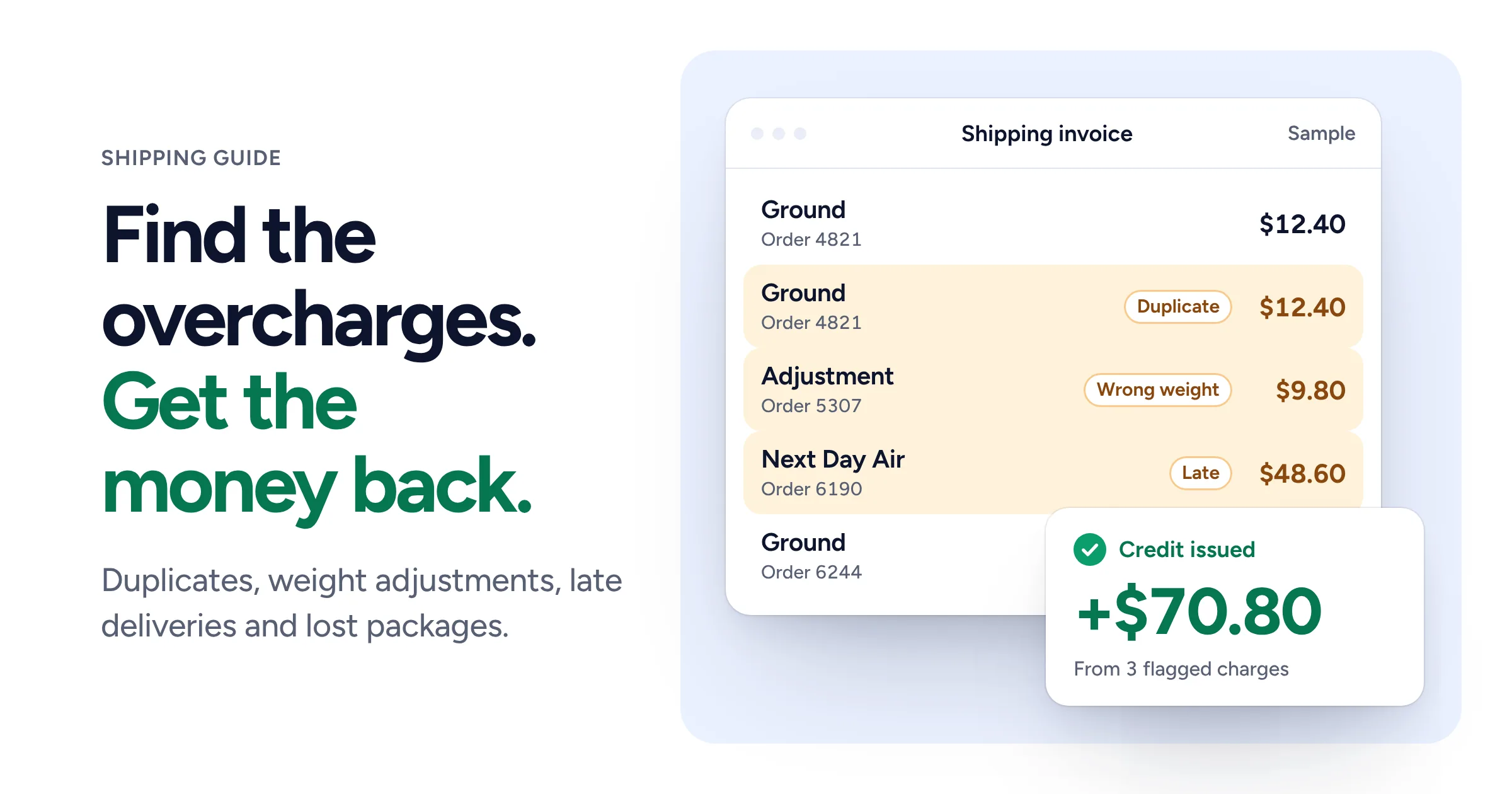
In the example month above, counting what the weekly checks caught, the seven flagged charges are a duplicate $12.40 label, three unused $9.85 labels, a $9.80 weight adjustment on a box that was weighed correctly, a $5.95 residential fee on a business address, and a $48.60 overnight label that arrived late:
$12.40 + (3 × $9.85) + $9.80 + $5.95 + $48.60 = $106.30
If every month looked like that one, the routine would be worth:
$106.30 × 12 months = $1,275.60 a year
Shipping audit checklist
| Check | What to compare | If it’s wrong |
|---|---|---|
| Duplicate charges | Tracking or order numbers billed twice | Dispute; void extra labels |
| Unused labels | Labels bought vs. labels the carrier scanned | Void or request a refund in time |
| Wrong service | Service billed vs. service bought | Dispute the difference |
| Weight and size | Billed weight and size vs. your packing records | Dispute with photos, or fix your box data |
| Residential fee | Address type billed vs. the real address | Dispute it on business addresses |
| Address correction | Corrected address vs. the order’s address | Dispute it if the address was right |
| Other surcharges | Each fee vs. its published trigger | Dispute it if the trigger doesn’t apply |
| Late delivery | Delivery time vs. the guarantee | Request a refund in time (15 calendar days at UPS and FedEx) |
| Lost or damaged | No delivery scan; customer damage reports | Claim with photos and proof of value |
How to automate shipping audits and claims
Running this routine by hand takes time every month, and a 15-day refund window is easy to miss. ShipSqueeze automatically audits every shipment for late deliveries, billing errors and overcharges, then files the claims and recovers the refunds for you. See how the automated shipping audit works.
It helps before you ship, too, because the same label can cost more on some platforms. ShipSqueeze checks 30+ label platforms for every order and shows you where it ships cheapest today, across USPS, UPS, FedEx, DHL and regional carriers. You can start on the Free plan with no credit card required.
Common questions about shipping audits
Can I get a refund if a UPS Ground or FedEx Ground package is late?
No. As of October 2026, both carriers list their money-back guarantee as suspended for ground services. The covered services change, so check the carrier’s guarantee page before you file.
How do I get a refund for a shipping label I didn’t use?
Void it where you bought it as soon as you know you won’t ship it. USPS labels from a label platform must be refunded within 30 days of printing, and Click-N-Ship labels within 30 days from your shipping history or 60 through its help desk. UPS lets you void a label yourself within 90 days.
What’s the difference between a shipping audit and a shipping claim?
The audit is the check: you compare each charge with what you shipped and dispute the ones that are wrong. A claim is one result of an audit: it asks the carrier to pay for goods that were lost or damaged, up to the package’s declared value or insurance. A full audit also requests late-delivery refunds.
Sources
- UPS: Service Guarantee
- FedEx Service Guide: Money-Back Guarantee
- USPS: Request a USPS Refund (Domestic)
- UPS: Void a Shipment
- UPS: How to Avoid Shipping Charge Corrections
- USPS PostalPro: Automated Package Verification (APV) System
- UPS Tariff/Terms and Conditions of Service (United States): Claims and Legal Actions
- FedEx: File a Claim
- USPS Domestic Mail Manual 609: Filing Indemnity Claims for Loss or Damage