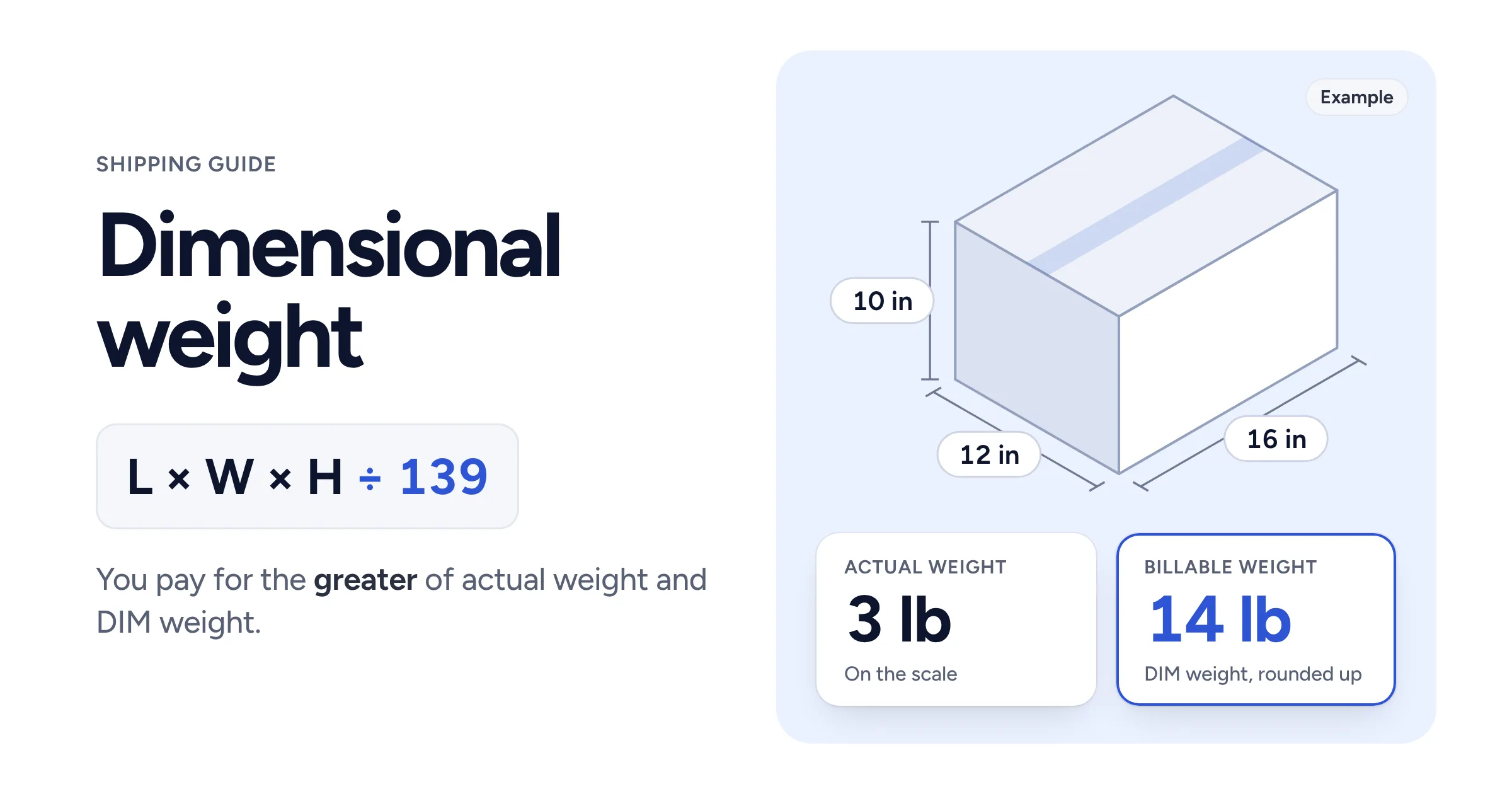
If you’ve ever shipped a light throw pillow in a big box and been charged as if it weighed 14 lb, you’ve met dimensional weight. Carriers price parcels by the space they take up as well as by what they weigh, so the box you pick can matter as much as what’s inside it. This guide shows how dimensional weight works at UPS, FedEx and USPS, with worked examples and practical ways to stop paying to ship air.
What is dimensional weight?
Dimensional weight, usually shortened to DIM weight, is a weight the carrier works out from a package’s size. A big box takes up the same room on a truck or plane whether it holds pillows or paperbacks, so carriers charge for that space as well as for the pounds.
Every label is priced on the billable weight: the greater of the package’s actual weight (what it weighs on a scale) and its dimensional weight. A dense package, like a box of books, is billed on its actual weight. A light, bulky one, like a pillow or a lampshade, is billed on its dimensional weight.
That’s why two orders that weigh the same can cost very different amounts to ship. The rate chart doesn’t change; the weight the carrier looks up in it does. The carrier then combines billable weight with the shipping zone, so every extra billable pound costs more the farther the package travels.
How to calculate dimensional weight
The formula is the same at every major US carrier. Only the divisor (the number you divide by, also called the DIM factor) changes.
Dimensional weight (lb) = length × width × height (in) ÷ divisor
- Measure the length, width and height in inches at the widest points, including any bulges.
- Round each measurement up to the next whole inch.
- Multiply the three numbers to get the volume in cubic inches.
- Divide by the carrier’s divisor and round any fraction up to the next whole pound.
- Compare the result with the actual weight, also rounded up to the next pound. The larger number is the billable weight.
Here’s a 16 × 12 × 10 in box holding a 3 lb order, at a divisor of 139:
16 × 12 × 10 = 1,920 cu in; 1,920 ÷ 139 = 13.81 → 14 lb DIM weight
Fourteen pounds beats the actual 3 lb, so the label is priced as a 14 lb package: more than four times what it weighs.
How to measure a box
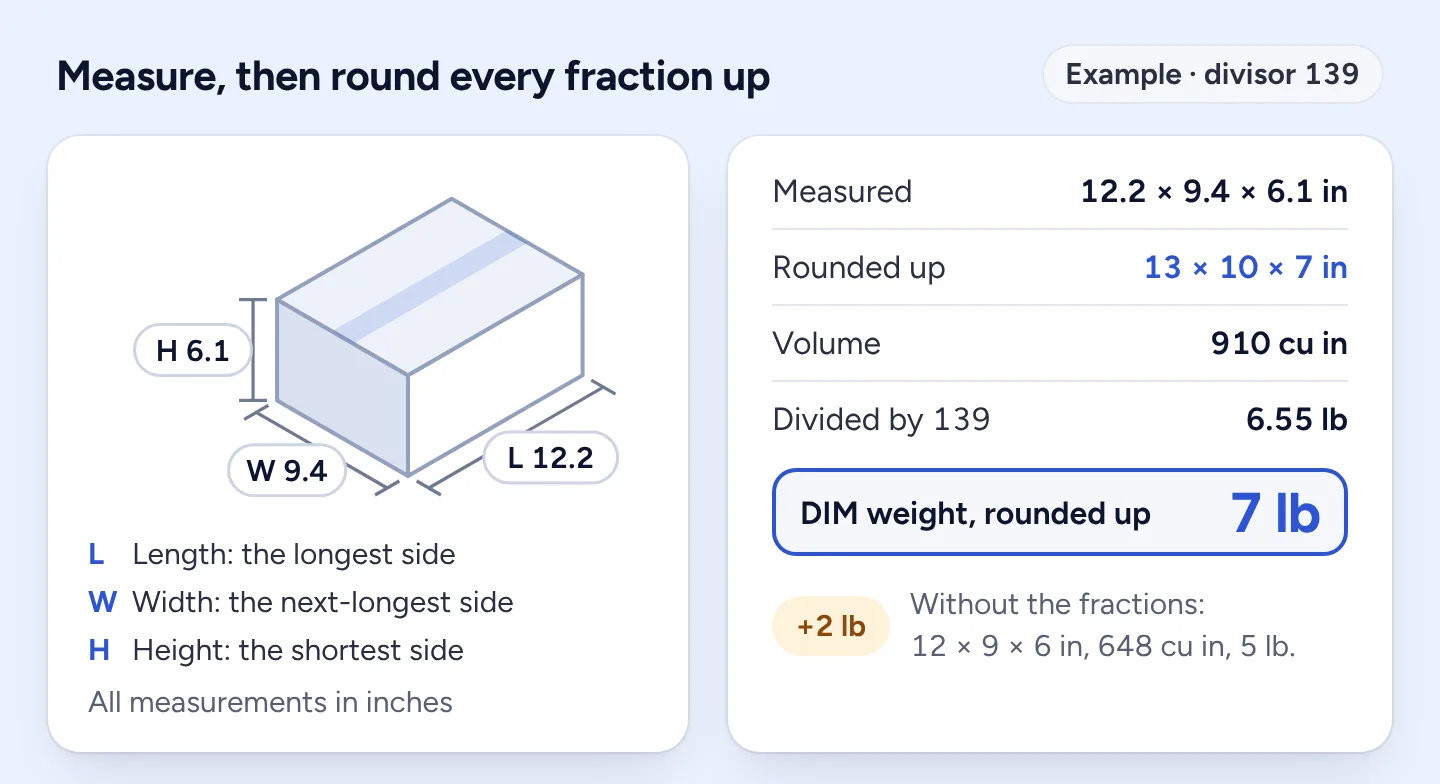
Length is always the longest side. Turn the box and measure the next-longest side for width; the shortest side is height. Measure the package as it will ship, sealed and taped, so a bulging flap or a lid that won’t sit flat counts.
Fractions matter more than they look. UPS and FedEx round every fraction of an inch up to the next whole inch, and USPS adopted the same rule for dimensional weight in July 2026. A box that measures 12.2 × 9.4 × 6.1 in is billed as 13 × 10 × 7 in.
Dimensional weight divisors for UPS, FedEx and USPS
A smaller divisor means a higher DIM weight for the same box. As of October 2026, the three big carriers line up like this:
| Carrier and rates | Divisor | When DIM weight applies |
|---|---|---|
| UPS Daily Rates | 139 | Any package size |
| UPS Retail Rates | 166 | Any package size |
| FedEx | 139 | Any package size |
| USPS | 139 | Parcels over 1 cu ft (1,728 cu in) |
At UPS, Daily Rates are generally for shippers with a UPS account, and Retail Rates for those without one, such as people shipping at The UPS Store. If you have a negotiated agreement with any carrier, check its terms for the divisor you’re billed at.
USPS changed its rules in July 2026. Since July 12, 2026, it divides by 139 instead of 166 and rounds each dimension up, for Priority Mail Express, Priority Mail and USPS Ground Advantage (retail and commercial) and for Parcel Select. Unlike UPS and FedEx, it still applies dimensional weight only to parcels larger than 1 cubic foot. At or under 1,728 cubic inches, USPS prices on actual weight alone.
Built your shipping rules before July 2026?
The USPS switch from 166 to 139 raises the DIM weight of every parcel over 1 cubic foot by about a fifth (166 ÷ 139 ≈ 1.19). Recheck any box presets, shipping rules or checkout rates that were built on the old divisor.
Small box vs. oversized box: a worked example
Take one order that weighs 3 lb once it’s packed. Here’s what happens when it ships in a box that fits versus a bigger box that happened to be on the shelf.
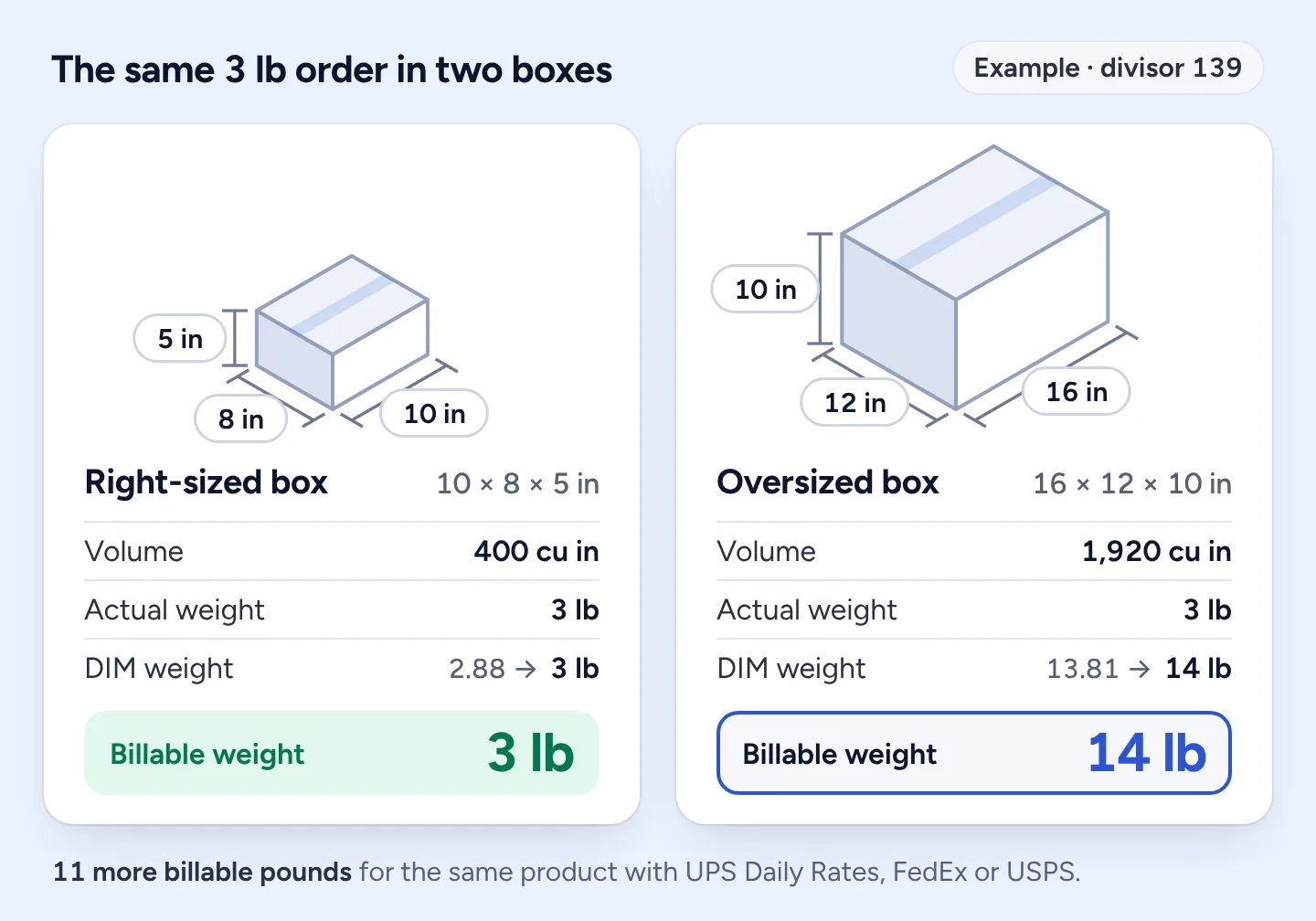
In the 10 × 8 × 5 in box, the volume is 400 cubic inches and the DIM weight is 2.88 lb, which rounds up to 3 lb. That matches the actual weight, so you pay for 3 lb at UPS, FedEx or USPS. In the 16 × 12 × 10 in box, FedEx, UPS Daily Rates and USPS all bill 14 lb (12 lb at UPS Retail Rates). USPS counts DIM weight here because 1,920 cubic inches is over its 1 cubic foot line.
Same product, same customer, 11 more billable pounds. What those pounds cost depends on the service and zone, so check your carrier’s current rate chart, but you’re paying to ship a 14 lb package that holds 3 lb of product.
DIM weight for common shipping box sizes
Use this table as a quick dimensional weight calculator for standard box sizes. Each figure is already rounded up to the next pound, as carriers do, and you pay whichever is greater: this number or the actual weight.
| Box size (in) | Volume (cu in) | UPS Daily, FedEx (÷ 139) | UPS Retail (÷ 166) | USPS (÷ 139) |
|---|---|---|---|---|
| 8 × 6 × 4 | 192 | 2 lb | 2 lb | Actual weight |
| 10 × 8 × 4 | 320 | 3 lb | 2 lb | Actual weight |
| 12 × 9 × 6 | 648 | 5 lb | 4 lb | Actual weight |
| 14 × 10 × 8 | 1,120 | 9 lb | 7 lb | Actual weight |
| 12 × 12 × 12 | 1,728 | 13 lb | 11 lb | Actual weight |
| 16 × 12 × 10 | 1,920 | 14 lb | 12 lb | 14 lb |
| 18 × 14 × 12 | 3,024 | 22 lb | 19 lb | 22 lb |
| 24 × 16 × 12 | 4,608 | 34 lb | 28 lb | 34 lb |
Look at the 12 × 12 × 12 in cube. At exactly 1,728 cubic inches it isn’t over 1 cubic foot, so USPS charges its actual weight, while FedEx and UPS Daily Rates bill it at 13 lb or more (11 lb at UPS Retail Rates). Add one inch to any side and it crosses into USPS DIM pricing too: 13 × 12 × 12 in is 1,872 cubic inches, or 14 lb.
How to reduce dimensional weight charges
Right-size your boxes
Stock a few box sizes that fit your best sellers with just enough room for protective packing, instead of one size that fits everything. Every inch you take off a side removes a whole slice of volume: going from a 16 × 12 × 10 in box to a 14 × 10 × 8 in box cuts the DIM weight from 14 lb to 9 lb at a divisor of 139.
A quick packaging check
List your ten best-selling products, note the box each one ships in, and look them up in the table above. If a product’s DIM weight is well above its actual weight, a smaller box or a mailer is often the cheapest fix you can make.
Switch soft goods to poly or padded mailers
Clothing, textiles and other items that can’t break don’t need a box. A mailer is only as thick as what’s inside it, so its volume, and its DIM weight, stays low.
Design around the USPS 1 cubic foot line
If most of your parcels go USPS, 1,728 cubic inches is the number to plan around. A 12 × 12 × 12 in box or a 16 × 12 × 9 in box sits exactly on it; anything bigger is billed on the greater of its actual weight and its DIM weight. Measure your box presets with the rounding rule in mind: a box listed at 12 in that really measures 12.25 in counts as 13.
Check USPS cubic and Flat Rate pricing
Cubic pricing is a commercial USPS option for Priority Mail and USPS Ground Advantage packages up to 20 lb, bought through shipping software rather than at a Post Office counter. The price depends on the package’s volume tier and zone instead of its weight, which can make small, heavy parcels cheaper. Cubic has its own measuring rules (fractions are rounded down to the quarter inch) and size limits, so check the current Domestic Mail Manual before you build around it.
Priority Mail Flat Rate boxes go the other way: one price for the box, to any state, for anything that fits up to 70 lb, so dimensional weight never applies. They’re worth comparing for heavy items going a long way.
Send accurate dimensions to avoid adjustments
Make sure the dimensions your store and shipping software send match the box you actually use. Carriers measure parcels in their networks. UPS bills a shipping charge correction when the weight or dimensions on the label are wrong, and USPS collects underpaid postage through your label provider with Automated Package Verification.
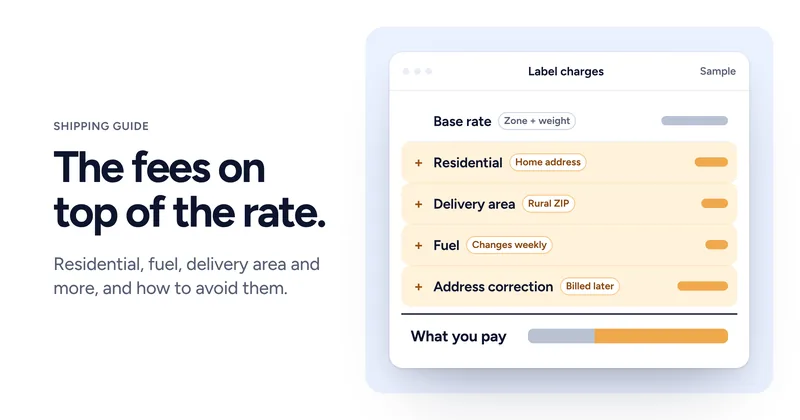
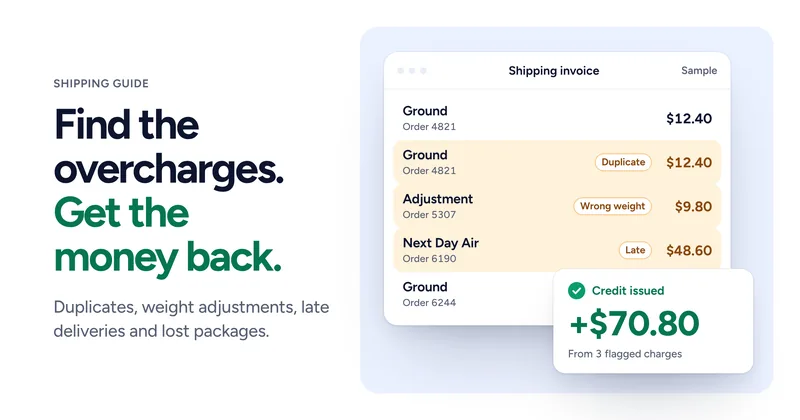
These adjustments arrive after the label is paid for, so check them. Our guide to finding shipping overcharges and claiming refunds shows how to spot wrong ones. Very large boxes can also trigger size-based surcharges on top of DIM weight.
Compare carriers package by package
Because USPS treats smaller boxes differently from UPS and FedEx, the cheapest carrier can change with the box. A light 14 × 10 × 8 in box bills at 9 lb with FedEx or UPS Daily Rates (7 lb at UPS Retail Rates), but at its actual weight with USPS. A dense package in the same box may come out cheaper with UPS or FedEx instead.
See the cheapest label for every box you ship
Dimensional weight is one reason the cheapest label changes from order to order. The platform you buy it on is another: see why the same shipping label costs more on some platforms.
ShipSqueeze checks 30+ label platforms for every order, across USPS, UPS, FedEx, DHL and regional carriers, and shows you where that package ships cheapest today. Orders come in from Shopify, WooCommerce, Amazon, eBay or Etsy with origin, destination, weight and size, and you can enter a package by hand to try a different box. You click through and buy the label on the winning platform.
If a label is later billed wrong, the ShipSqueeze shipping audit checks every shipment for billing errors and overcharges, files claims and recovers refunds. The Free plan needs no credit card.
Common questions about DIM weight
Does USPS use dimensional weight?
Yes, for Priority Mail Express, Priority Mail, USPS Ground Advantage and Parcel Select parcels larger than 1 cubic foot (1,728 cubic inches). Since July 12, 2026, the divisor is 139. Priority Mail Flat Rate packaging is priced by the box, so DIM weight doesn’t apply.
Does dimensional weight apply to poly mailers?
It can. UPS and FedEx measure a mailer like any other package, at its longest, widest and thickest points. A filled mailer is thin, so its DIM weight is usually much lower than a box’s for the same item.
For very light items it can still beat the actual weight, though: a 12 × 10 × 2 in mailer is 240 cubic inches, or 2 lb at a divisor of 139. At USPS, a mailer at or under 1 cubic foot is priced on actual weight.
Why was I charged more than the label price?
Usually because the carrier weighed or measured the package and got a different result from the label. UPS calls this a shipping charge correction; USPS collects it through Automated Package Verification. Compare the adjusted dimensions with the box you used, and dispute the charge if they don’t match; our guide to shipping audits walks through it.
Is there a quick dimensional weight calculator?
You don’t need one for a quick check. Round each side up to the next inch, multiply them, divide by your carrier’s divisor (139 for UPS Daily Rates, FedEx and USPS; 166 for UPS Retail Rates) and round up. If the result is higher than the actual weight, that’s what you’ll pay for. At USPS, that only applies when the box is over 1,728 cubic inches.
Sources
- UPS: Shipping dimensions and weight
- UPS: How to avoid shipping charge corrections
- FedEx: What is dimensional weight? (divisor 139 and billable weight)
- FedEx Service Guide 2026 (dimensional weight and rounding rules)
- USPS: Priority Mail (dimensional weight and Flat Rate)
- Federal Register: USPS Domestic Competitive Products Pricing and Mailing Standards Changes (May 15, 2026)
- USPS Domestic Mail Manual 223: Priority Mail commercial prices, including cubic
- USPS: Automated Package Verification for domestic packages