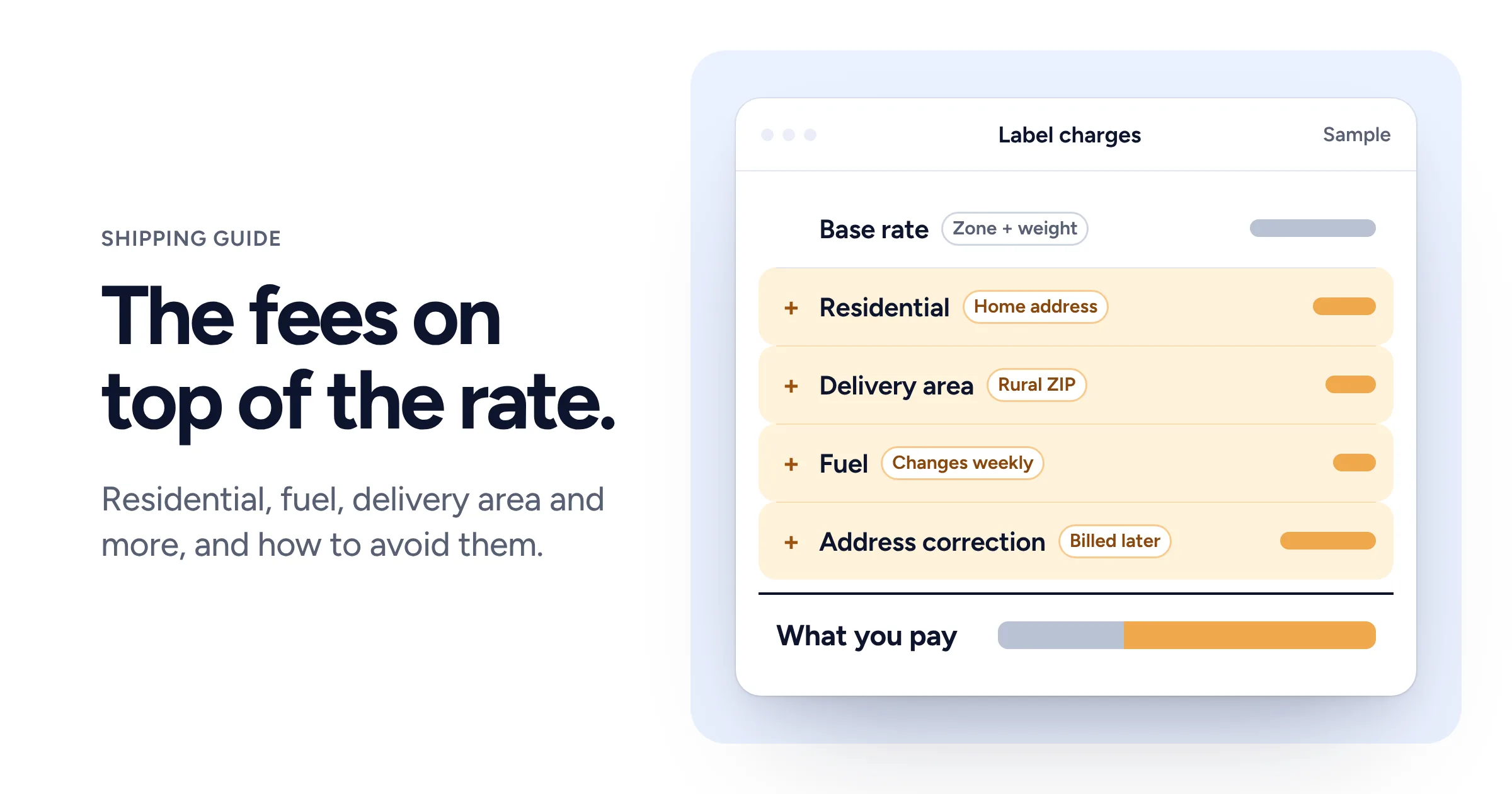
Shipping surcharges are the fees carriers add on top of a label’s base rate: for delivering to a home or a remote ZIP code, for fuel, for big or awkward boxes, and for mistakes in the address. On a small package they can make up a large share of what you pay. This guide explains what triggers each fee, who charges it, and how to avoid it.
What are shipping surcharges?
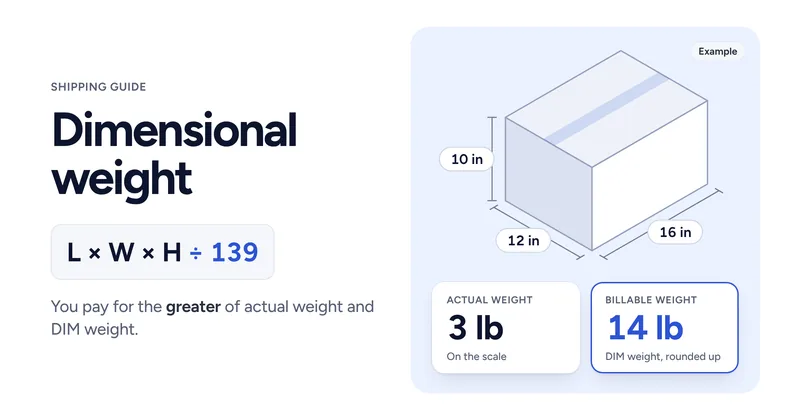
Every label starts with a base rate, set by the service, the shipping zone (how far the package travels) and the billable weight: the greater of the actual weight and the dimensional weight. Surcharges are extra charges added when a shipment meets certain conditions: where it’s going, when it ships, how big or heavy it is, or what went wrong with it.
Carriers also call them accessorial charges. UPS and FedEx list many in their service guides; USPS has fewer and builds most price changes into postage.
Some surcharges show up when you buy the label. Others arrive later as an adjustment, when the carrier finds a wrong address or measures a different size.
What you pay = base rate + surcharges + fuel surcharge + extras you choose
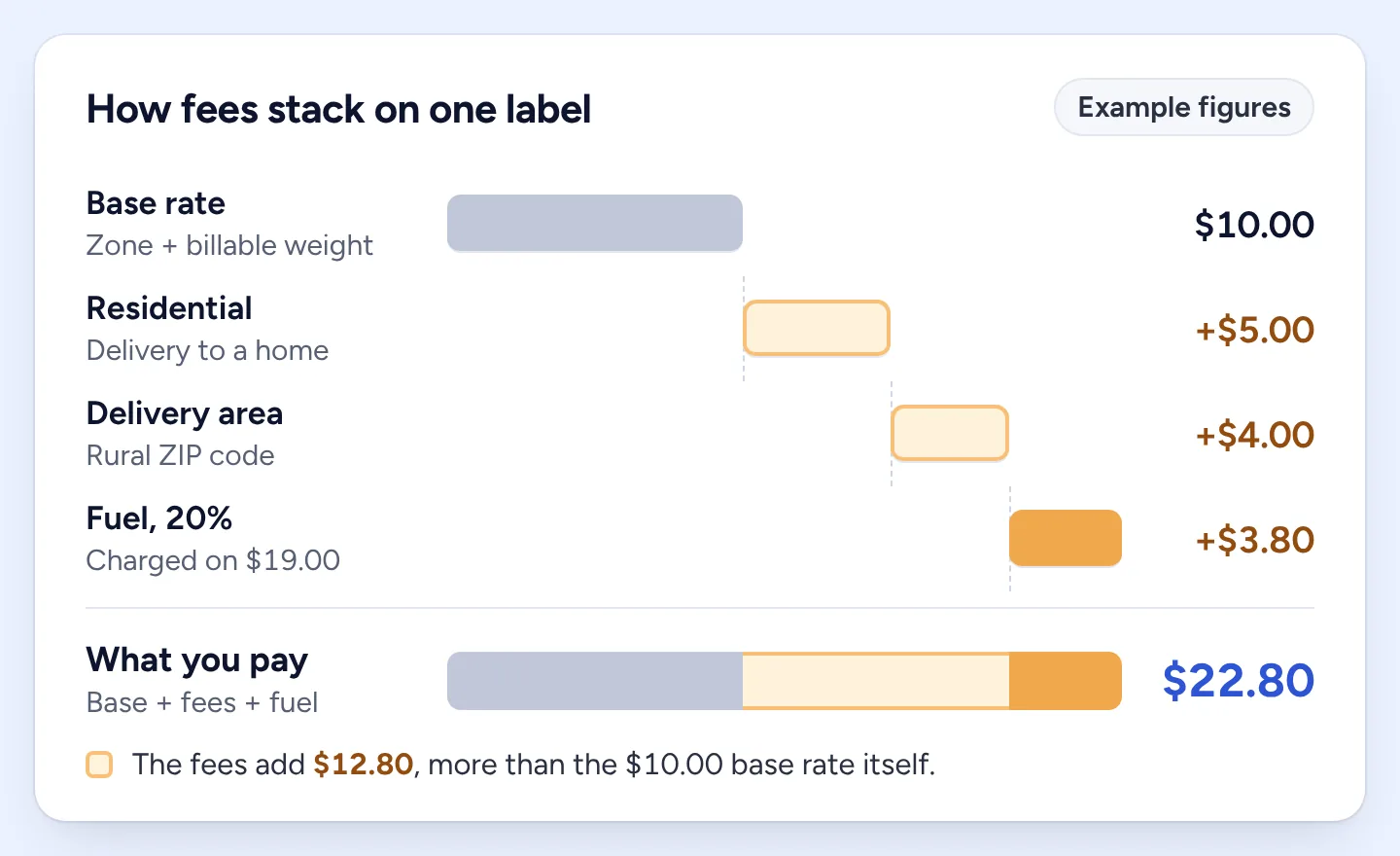
The fuel surcharge is a percentage, and UPS and FedEx charge it on surcharges such as residential and delivery area as well as on the base rate, so the fees compound. In the example below, a $10.00 base rate becomes $22.80 ($10.00 + $5.00 + $4.00 = $19.00, plus 20% fuel on $19.00, which is $3.80): more than double the rate you might have compared.
Residential, delivery area, fuel and peak-season surcharges
Residential surcharge
What triggers it: delivering to a home. UPS and FedEx both charge it (at FedEx, on Home Delivery and on Express packages to homes), and UPS counts a business run out of a home as residential too.
How to avoid or reduce it: compare USPS, which doesn’t charge one. FedEx drops the residential charge when the package is held at a FedEx location for pickup. And check that business customers aren’t flagged as residential in your shipping software.
Delivery area surcharge (DAS)
What triggers it: a destination ZIP code on the carrier’s list of harder-to-reach areas, mostly rural and outlying places. UPS and FedEx both have a standard delivery area surcharge and a higher extended rate, plus remote-area charges for Alaska and Hawaii; FedEx also has a remote tier for some ZIP codes in the lower 48. Amounts often differ for residential and commercial addresses.
How to avoid or reduce it: check the carriers’ ZIP code lists, which change during the year, and compare USPS for rural deliveries.
Light package to a home? Check USPS first
For a 1–2 lb parcel going to a rural home, the UPS or FedEx residential and delivery area fees can decide which carrier is cheapest, so price USPS Ground Advantage and Priority Mail before you buy.
Fuel surcharge
What triggers it: every UPS and FedEx shipment. It’s a percentage each carrier resets weekly from U.S. Energy Information Administration fuel prices: diesel for ground services and jet fuel for air. Both carriers charge it on the base rate and on many surcharges, including residential, delivery area, additional handling and large package or oversize.
How to avoid or reduce it: you can’t opt out, but you can compare full prices with fuel included: a cheaper base rate with more surcharges also pays fuel on those surcharges. Carriers post current percentages, for example on FedEx’s weekly fuel surcharge page.
USPS has no weekly fuel surcharge. It changes postage instead: from April 26, 2026 to January 17, 2027, a time-limited 8% increase applies to base postage for Priority Mail Express, Priority Mail, USPS Ground Advantage and Parcel Select.
Peak-season (demand) surcharges
What triggers it: shipping in the busy season. As of October 2026, UPS and FedEx have published 2026 demand surcharges on residential packages and on packages that already carry an additional handling, large package or oversize charge. They run from late September 2026 to mid-January 2027, with residential charges starting in late October and the highest amounts from late November to late December. USPS has a temporary holiday price change instead, from October 4, 2026 to January 17, 2027, on the same four parcel services.
How to avoid or reduce it: ship large items before the windows open, and recheck which carrier is cheapest once holiday pricing starts, because the gap between carriers moves.
Additional handling, oversize and USPS nonstandard fees
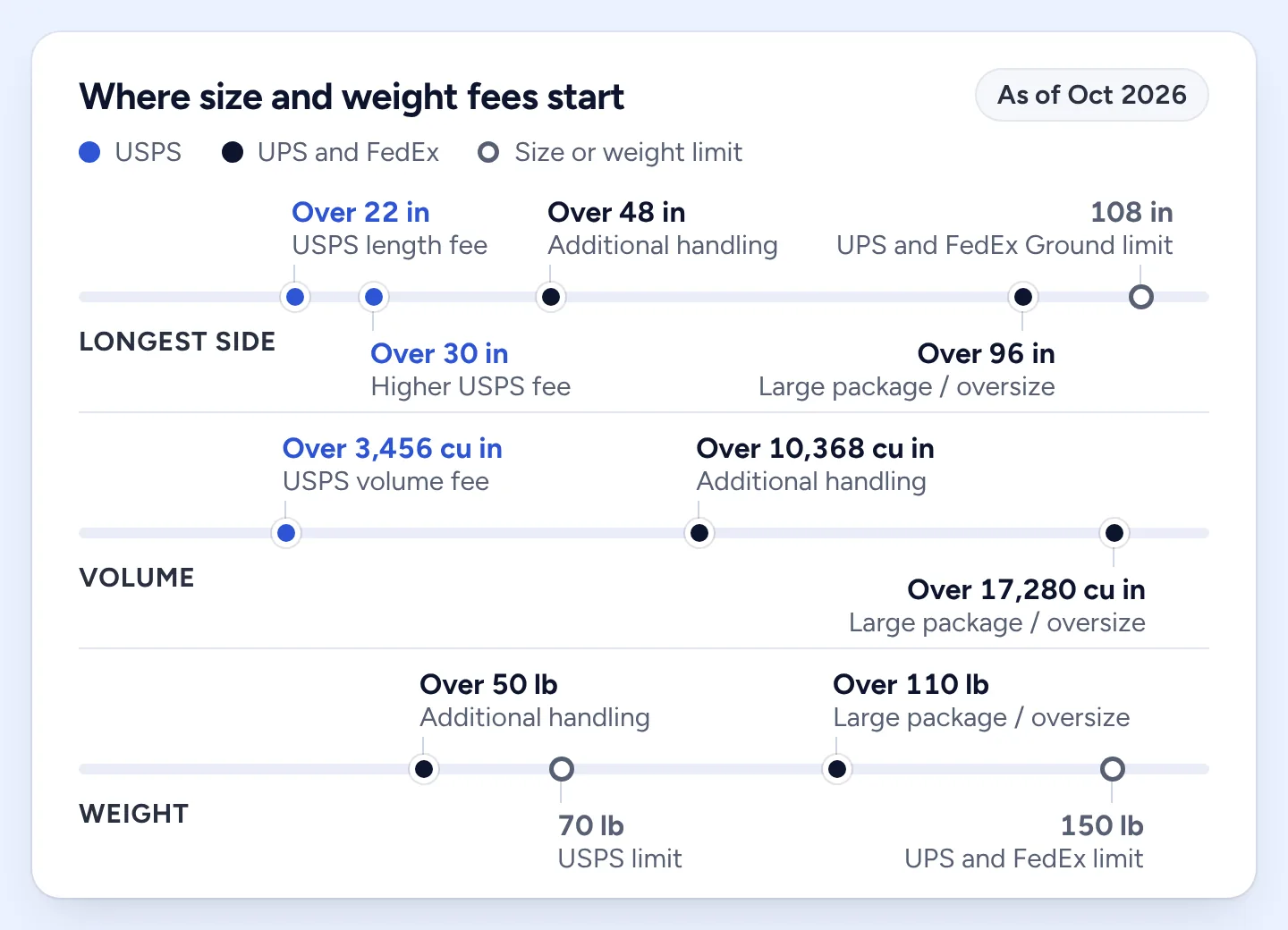
Size and weight fees are the easiest surcharges to avoid, because each starts at an exact threshold. The figure shows where they begin.
Additional handling (UPS and FedEx)
What triggers it: as of October 2026, a longest side over 48 in, a second-longest side over 30 in, an actual weight over 50 lb, or a volume (length × width × height) over 10,368 cubic inches, which is 6 cubic feet. Both carriers added the volume rule in January 2026. FedEx also applies it when length plus girth (the longest side plus twice the width plus twice the height) is over 105 in.
Packaging counts too. An item not fully enclosed in a corrugated cardboard box, such as a plastic tote, a wrapped bundle, or a cylinder like a bucket or tire, can trigger the fee at any size.
24 × 24 × 20 in = 11,520 cubic inches: over 10,368, so additional handling applies. 24 × 22 × 18 in = 9,504 cubic inches: under the limit.
How to avoid or reduce it: use the smallest corrugated box that fits, split a heavy order into two packages under 50 lb when two labels cost less than one surcharged one, and recheck old boxes: one that was fine in 2025 can now trigger the fee on volume alone.
Large package, oversize and over-maximum charges
One step up, UPS charges a large package surcharge and FedEx an oversize charge when a package is over 96 in long or has a length plus girth over 130 in, or, since January 2026, has a volume over 17,280 cubic inches (10 cubic feet) or weighs over 110 lb. These packages are billed at a minimum of 90 lb.
UPS and FedEx Ground don’t accept parcels over 150 lb, over 108 in long, or with a length plus girth over 165 in (FedEx Express allows up to 119 in long). Ones that slip through get a UPS over maximum limits charge or a FedEx Ground unauthorized package charge. Ship these by freight.
USPS nonstandard fees
What triggers it: long or bulky Priority Mail Express, Priority Mail, Ground Advantage or Parcel Select parcels. One fee applies when the longest side is over 22 in, up to 30 in, a higher fee over 30 in, and a separate fee when the volume is over 2 cubic feet (3,456 cubic inches). Check Notice 123 for the current fees, which differ by service.
USPS caps parcels at 70 lb and, for most services, a length plus girth of 108 in. Ground Advantage and Parcel Select accept larger parcels at oversized prices, up to 130 in for Ground Advantage. Commercial Priority Mail and Ground Advantage parcels over 1 cubic foot or 22 in long can also get a dimension noncompliance fee if their dimensions are missing or wrong, so always enter the box size.
26 × 8 × 4 in: longest side over 22 in, so the length fee applies. 18 × 16 × 14 in = 4,032 cubic inches: over 3,456, so the volume fee applies.
Keep the long side at 22 inches
If the product fits, a box with a longest side of 22 in or less avoids the USPS length fee, and staying at or under 3,456 cubic inches avoids the volume fee. At USPS, boxes over 1 cubic foot are also priced on dimensional weight, so a smaller box can save twice.
Address corrections, signatures and declared value
Address correction fee
What triggers it: a wrong or incomplete address that UPS or FedEx has to fix before it can deliver. It’s charged on each package the carrier has to correct, and because the driver finds the problem on the road, it reaches your bill after the label was bought.
How to avoid it: validate addresses at checkout and again before you buy the label, and watch for missing apartment or suite numbers.
Signature options
Signature services, such as USPS Signature Confirmation or FedEx Adult Signature Required, cost extra at all three carriers. FedEx adds Direct Signature Required free to packages declared at $500 or more. Add a signature only when an order needs one, such as a high-value or age-restricted item.
Declared value and insurance
UPS and FedEx include $100 of liability per package, and declaring a higher value costs extra. USPS Priority Mail and Ground Advantage include insurance up to $100. Check what’s included before paying for cover you already have.
Some fees arrive after you ship
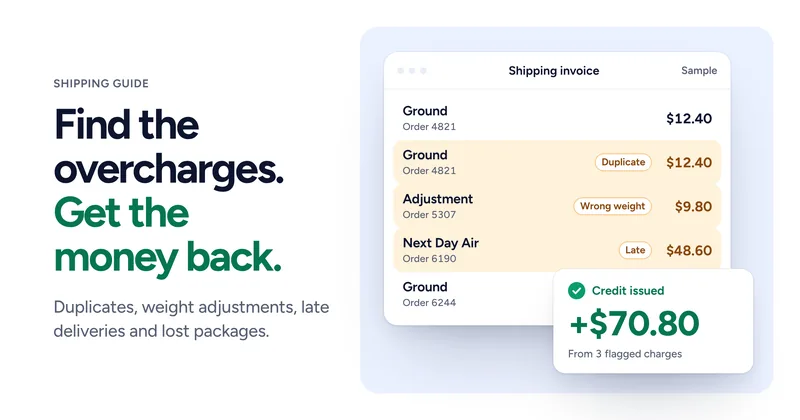
Address corrections and re-measured packages show up as adjustments days or weeks later, so check your bills regularly. Our guide to shipping audits and refunds shows how to dispute them.
Shipping surcharges at a glance: triggers and fixes
Use this checklist when a label costs more than expected. Amounts change, so check the carrier’s current rate guide or USPS Notice 123 for today’s prices.
| Fee | Who charges it | What triggers it | How to avoid or reduce it |
|---|---|---|---|
| Residential | UPS, FedEx | Delivery to a home | Compare USPS; FedEx Hold at Location |
| Delivery area (DAS) | UPS, FedEx | ZIP code on the carrier’s list | Compare USPS for rural ZIP codes |
| Fuel | UPS, FedEx | Every shipment; reset weekly | Compare the full price, fuel included |
| Demand (peak) | UPS, FedEx; USPS holiday prices | Shipping in peak windows | Ship large items early |
| Additional handling | UPS, FedEx | Over 48 in long, 30 in second side, 50 lb or 10,368 cu in; no cardboard box | Smaller corrugated box; split heavy orders |
| Large package / oversize | UPS, FedEx | Over 96 in long, 130 in length plus girth, 17,280 cu in or 110 lb | Smaller packaging or freight |
| Over maximum | UPS, FedEx Ground | Over 150 lb, 108 in long or 165 in length plus girth | Ship by freight |
| Nonstandard fees | USPS | Over 22 in or 30 in long; over 3,456 cu in | Keep the long side at 22 in or less |
| Address correction | UPS, FedEx | Wrong or incomplete address | Validate before buying |
| Signature, declared value | All three, if you add them | Options chosen at purchase | Add only when needed |
Compare all-in label prices and catch billing errors
Surcharges are why the cheapest base rate isn’t always the cheapest label: the same box can pick up residential and delivery area charges at one carrier and neither at another. They’re also part of why the same label can cost more on some platforms.
ShipSqueeze checks 30+ label platforms for every order, across USPS, UPS, FedEx, DHL and regional carriers, and shows you where that package ships cheapest today. Orders from Shopify, WooCommerce, Amazon, eBay or Etsy come in with the destination, weight and size filled in, and you buy the label on the winning platform. After you ship, the shipping audit checks every shipment for billing errors and overcharges, files claims and recovers refunds. Start on the Free plan, with no credit card required.
Common questions about shipping surcharges
Does USPS charge a residential surcharge?
No. USPS adds no residential or delivery area surcharge to Ground Advantage or Priority Mail. Its 2026 time-limited and holiday price increases are built into postage, and nonstandard fees still apply.
Why was I charged a surcharge after I bought the label?
Usually the carrier found something different from the label: a wrong or incomplete address, a different weight or size, or packaging that triggers additional handling. Compare each adjustment with what you entered, and dispute the ones that don’t match.
How often does the fuel surcharge change?
Every week at UPS and FedEx. At UPS, for example, the new percentage takes effect each Monday, so the same label can cost a little more or less from one week to the next.
Can I get a surcharge refunded?
Yes, if it was applied by mistake. A residential charge on a business address, or an additional handling fee on a box under every limit, can be disputed with the carrier or the platform that sold the label. See our guide to shipping audit refunds.
Sources
- UPS: Fuel Surcharges
- UPS: How to Avoid Shipping Charge Corrections (additional handling, large package and maximum limits)
- UPS: Demand Surcharges, August 26, 2026 update (PDF)
- UPS: 2026 Tariff/Terms and Conditions of Service, United States (PDF)
- FedEx Service Guide 2026 (PDF)
- FedEx: Demand Surcharges
- USPS: Notice 123, Price List
- USPS: Transportation-Related, Time-Limited Price Change (March 25, 2026)
- USPS: Temporary Price Change for 2026 Holiday Shipping Season (August 25, 2026)