A return usually means paying for shipping twice: once to deliver the order and again to bring it back. Return shipping costs climb quietly, through labels you pay for but customers never use, express services nobody needed and oversized boxes billed by dimensional weight. Here’s how to cut what you spend, label by label and policy by policy, without making returns harder for your customers.
What drives return shipping costs?
A return label is priced like any other parcel. The carrier charges for the service, the billable weight of the box the customer sends back (its actual weight or its dimensional weight, whichever is greater) and the zone, which measures how far the package travels from your customer to you. Some return label types add a per-label fee on top.
Over a month, the total comes down to three numbers: how many returns you pay for, what each label costs, and whether you also pay for labels that never get used.
Monthly return shipping cost = orders × return rate × price per return label
Take a store with 1,000 orders a month, a 6% return rate and an $8.50 average return label (example figures): 1,000 × 0.06 × $8.50 = $510 a month. That assumes you pay only for labels that ship. Each part of the formula is a lever: the label type decides whether unused labels cost you anything, the service and the box set the price per label, and your return policy decides how many returns you pay for.
Return label options: in the box, on request or by QR code
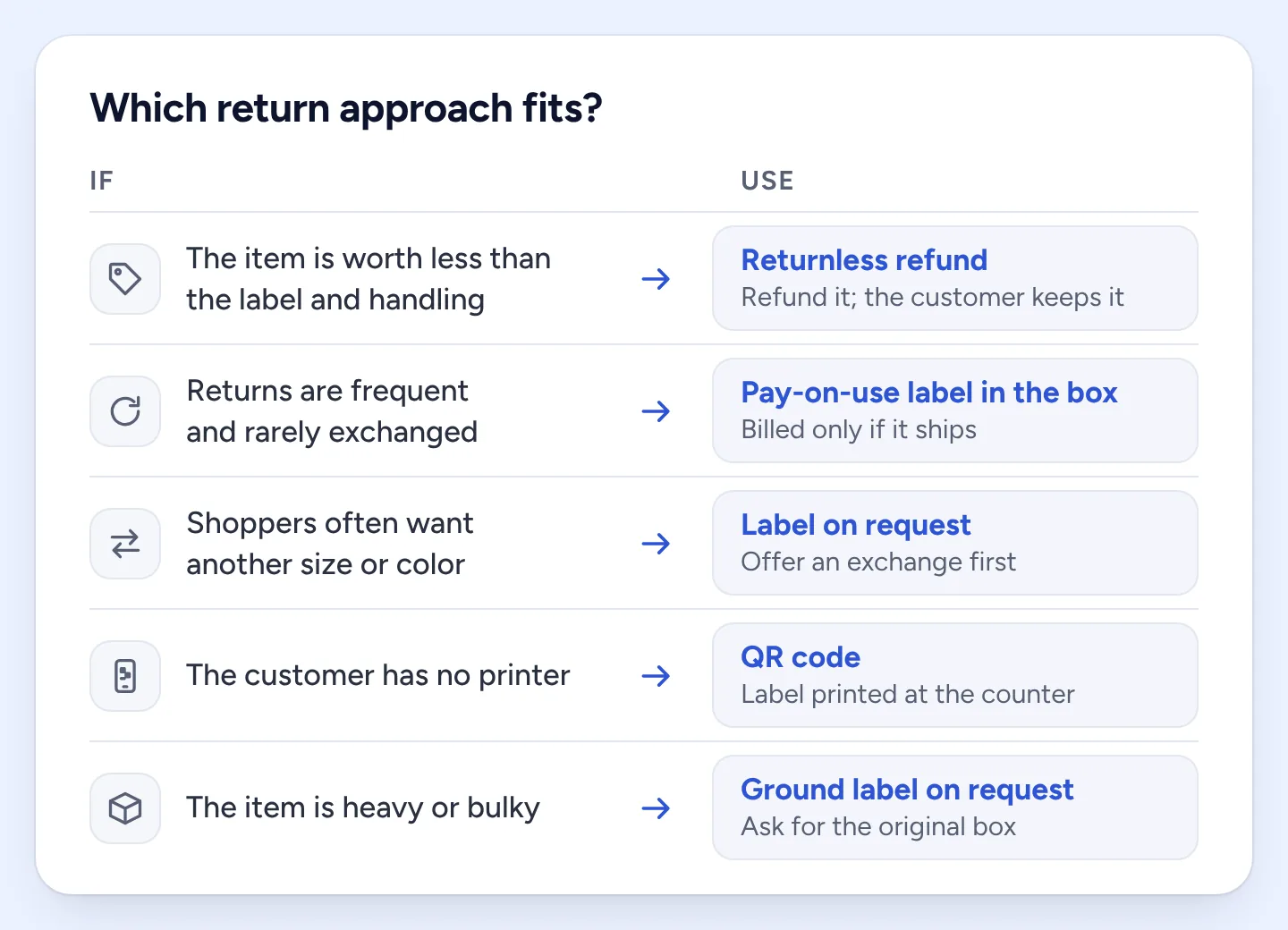
How the customer gets the label decides how easy the return is and when you pay for it. You can offer one of these four options or combine them.
A prepaid return label in the box
You print a return label with the order and pack it inside. It’s the easiest return for the customer: reuse the packaging, stick on the label and drop it off. Only do this with pay-on-use labels (more on those below). A regular label with the addresses swapped is usually paid for when you buy it on a label platform, so you’d pay for a return on every order, including the ones that never come back.
A return label on request
The customer starts a return on your returns page or by email, and you send a label they print at home. The extra step is useful: it lets you ask for a reason, suggest an exchange or store credit, and approve a refund without a return when that’s cheaper.
QR codes and label-free returns
Customers without a printer can show a code instead. With USPS Label Broker, the customer brings a QR code or Label Broker ID to a participating Post Office, where the label is printed at the counter. FedEx customers can show a FedEx QR code at FedEx Office, a FedEx Ship Center or a participating Walgreens to have the label printed.
UPS can email a return label with a mobile barcode, and its Happy Returns service takes box-free, label-free returns at Return Bar and The UPS Store locations for retailers that sign up.
Mailed labels and pickups
Carriers can also print a label and mail it to the customer (UPS Print & Mail Return Label, USPS Label Delivery Service), or have a driver bring the label to the door at pickup (UPS). These cost extra per label, so save them for customers who can’t print a label or get to a counter.
| Option | How you’re billed | Best for |
|---|---|---|
| Label in the box | When used (pay-on-use) or when bought | Frequent returns, few exchanges |
| Label on request | When used, if pay-on-use | Offering an exchange first |
| QR code | When used, if pay-on-use | Customers without a printer |
| Mailed label or pickup | Shipping plus a per-label fee | Can’t print or get to a counter |
Pay-on-use return labels: pay only for returns that ship
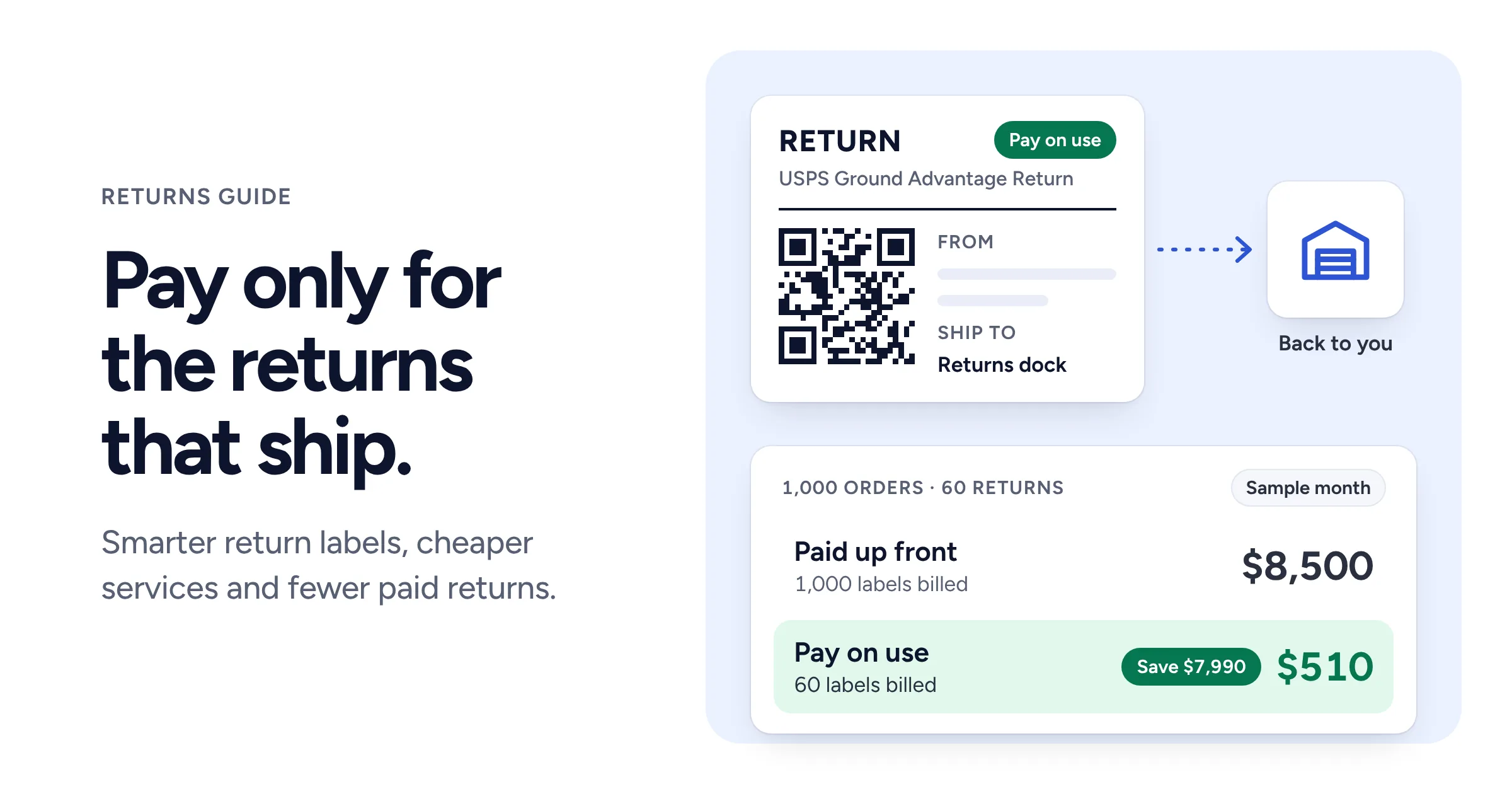
A pay-on-use return label, also called a scan-based label, is billed only when the package gets its first scan. Labels that sit unused in a drawer or an inbox cost you no postage. All three major carriers offer them:
- USPS return labels can be printed for free, and businesses are charged only once they’re used. Postage is based on the weight of the return package and the zone it travels, and you can choose Priority Mail Express, Priority Mail or USPS Ground Advantage return service.
- UPS bills the return shipping when the package ships. Some return types, such as emailed labels and labels UPS prints and mails for you, carry an extra per-package fee; the UPS rate guide lists the current amounts and when they apply.
- FedEx doesn’t charge for printed or emailed return labels until they’re used, and then you pay for the shipping plus any applicable surcharges.
You can create them with the carrier or through a label platform that supports returns. Before you put a label in every box, ask your platform how it bills return labels: as pay-on-use labels, or as regular labels charged when they’re created.
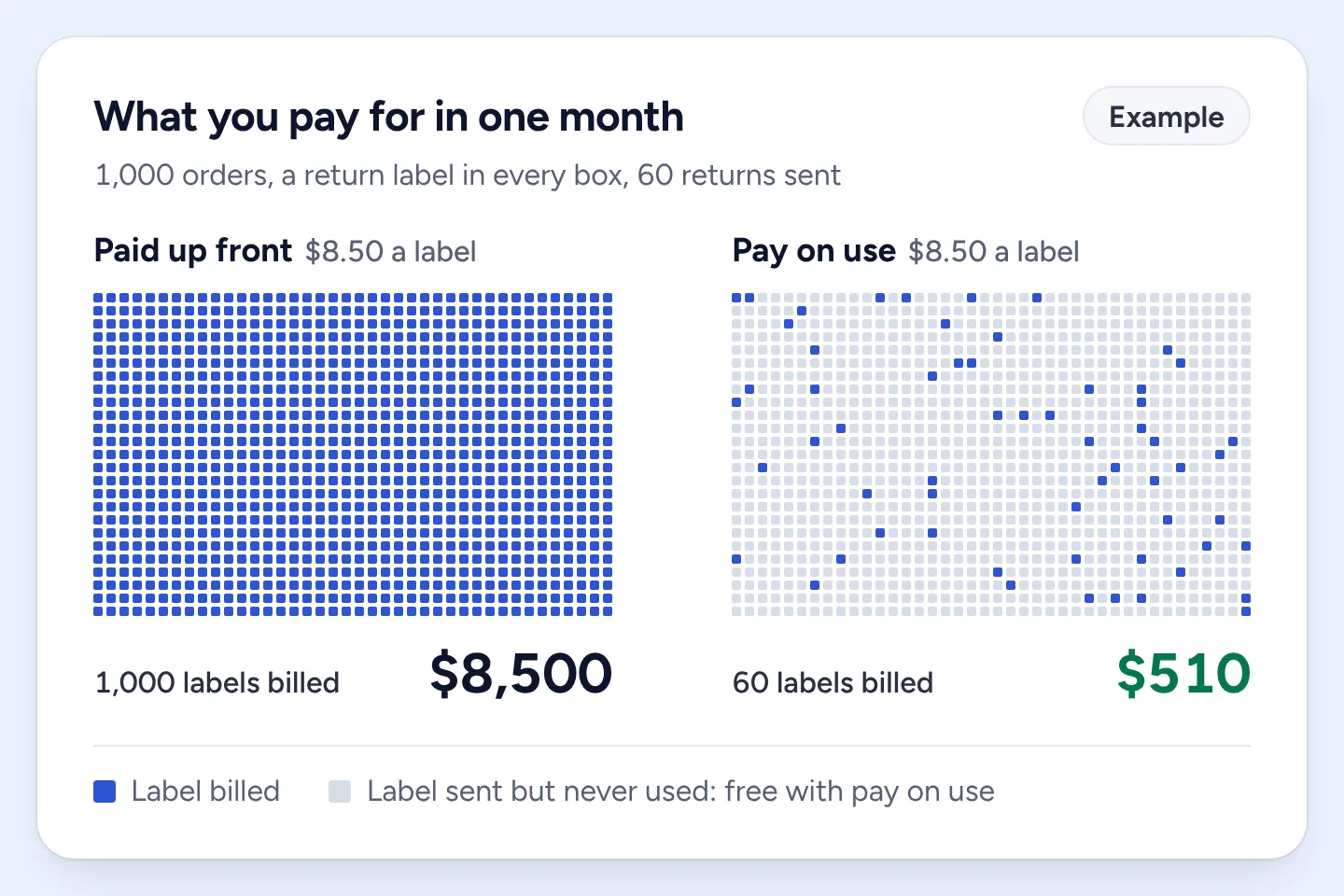
Here’s the same example store, with a return label in every box, billed three ways:
| Return label setup | Labels you pay for | Price per label | Monthly cost |
|---|---|---|---|
| Paid up front, Ground Advantage | 1,000 | $8.50 | $8,500 |
| Pay-on-use, Ground Advantage Return | 60 | $8.50 | $510 |
| Pay-on-use, Priority Mail Return | 60 | $11.40 | $684 |
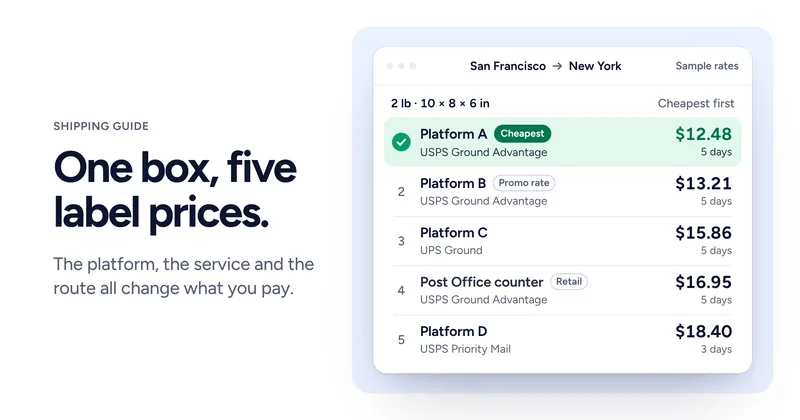
At the same $8.50 ground price, switching to pay-on-use labels takes the bill from $8,500 to $510. Sending those 60 returns by Priority Mail Return instead would add $174 a month, for $684. Real label prices depend on the weight, the distance and where you buy the label; our guide to why the same label costs more on some platforms explains the gaps.
Check how last month’s returns were billed
Count the return labels you paid for and the return packages that actually arrived. If the first number is bigger, you paid for labels nobody used; with pay-on-use labels, those would have cost you no postage.
How to lower the price of each return label
Send returns by ground
Most ecommerce returns aren’t urgent, and each of the three carriers offers return labels for its ground service. The slower service is usually the cheaper one, and the gap tends to grow with weight and distance.
If a customer is waiting on an exchange, ship the replacement when the return gets its first carrier scan instead of paying to speed up the return.
Keep returns out of dimensional weight pricing
You pay for the box the customer sends, not the one you’d have picked. Say a customer sends a 2 lb sweater back in an 18 × 14 × 12 in box from their garage. It’s billed on dimensional weight: UPS Daily Rates, FedEx and USPS all divide by 139 (as of October 2026; USPS switched from 166 on July 12, 2026 and applies it only to boxes over 1 cubic foot, like this one).
18 × 14 × 12 = 3,024 cubic inches ÷ 139 = 21.8, billed as 22 lb instead of 2 lb
Ship in packaging that can make the trip back, such as a box that opens without tearing or a mailer with a second adhesive strip, and ask customers in your return instructions to reuse it. Our dimensional weight guide has the full rules, including how each carrier measures and rounds.
Send returns to the closest location
Zone pricing works in reverse: a return from a nearby state costs less than one from across the country. If you ship from more than one warehouse, address each return label to the location nearest the customer, or to whichever one restocks that item. Our guide to how shipping zones work shows how much distance moves the price.
Bundle what you can
When a customer returns several items from one order, issue one label for all of them instead of one per item. At higher volumes, ask carriers about consolidated return programs, such as FedEx Easy Returns, which accepts drop-offs with no box or label.
How to pay for fewer returns
The cheapest return label is the one you never issue. Your return policy decides how many labels you pay for, and the reasons customers give tell you how to prevent the next return.
Set a clear return window and conditions
State how long customers have, for example 30 days from delivery, and what condition items must be in. A clear window stops late returns of seasonal stock you can no longer sell at full price, and clear conditions cut disputes over worn or used items. If you sell on Amazon, eBay or Etsy, check each marketplace’s return rules as well.
Decide who pays for the label
Free returns are the easiest for customers and the most expensive for you. Middle paths include free returns for exchanges and store credit, with a flat fee deducted from cash refunds, or free returns only on orders above a set value. Whatever you choose, put it on product pages and in the order confirmation so nobody is surprised.
Offer exchanges and store credit first
An exchange still needs a return label and a new outbound label, but you keep the sale instead of refunding it. Store credit keeps the revenue too. Offer both at the start of the return request, before the refund option.
Refund low-value items without a return
A returnless refund means refunding the customer and letting them keep the item. It makes sense when bringing the item back costs more than you’d recover from it:
Bring it back only if: resale value you’d recover > return label + handling
Say a returned item would resell for $9.00 after inspection, the return label costs $8.50, and unpacking, checking and restocking it takes $2.50 of staff time. You’d spend $11.00 to recover $9.00, so a returnless refund leaves you $2.00 better off, and your customer gets their money sooner.
Put limits on returnless refunds
Use a value threshold rather than offering them on everything, and keep a record per customer so one buyer can’t claim them on every order. Ask for a photo when the reason is damage or a wrong item.
Log return reasons and fix the top causes
Ask for a reason with every return request, from a short fixed list (wrong size, not as described, arrived damaged, arrived late, changed mind) so you can count them. Then fix the biggest group first: clearer size charts and photos for fit and description problems, sturdier packaging for damage.
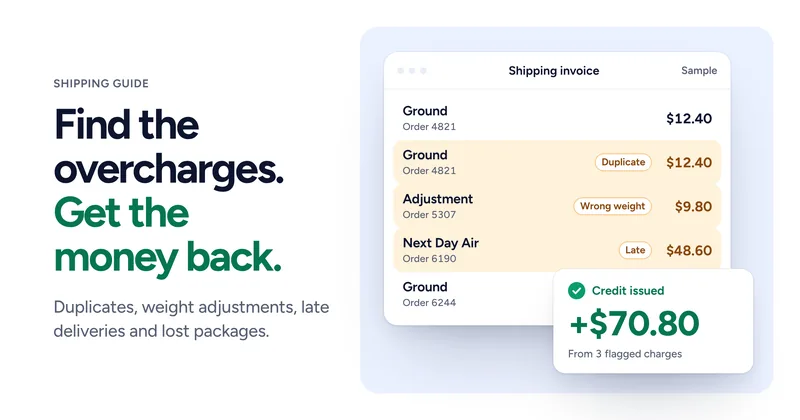
Damaged and late packages can also be grounds for a carrier claim or refund; our guide to shipping audits and refunds explains how to find and claim them.
Create return labels in seconds and pay less for them
ShipSqueeze handles the label side of returns: you can generate a return label and send it to your customer in seconds, then track the package on its way back. Sellers save up to 76% on return shipping costs, and the return label tools page shows how it works.
The exchange you send out can cost less too. For outbound orders, ShipSqueeze checks 30+ label platforms and shows you where each one ships cheapest today. Its automatic shipping audit checks every shipment for late deliveries, billing errors and overcharges, then files the claims for you. You can start on the Free plan, with no credit card required.
Common questions
Who pays for return shipping, the seller or the buyer?
Your return policy decides, within the rules of any marketplace you sell on. One common approach: cover returns caused by your own mistake, such as a wrong or damaged item, and charge a flat fee or deduct the label cost when the customer changed their mind.
How much does a return label cost?
It’s priced the way any parcel is: by the service, the billable weight and the distance, plus any per-label fee for the return type. To get a real number, quote the trip in reverse, from your customer’s ZIP code to yours, with the box they’re likely to use.
Do I pay for return labels customers never use?
Not with pay-on-use labels: USPS, UPS and FedEx bill the postage on those only when the package ships. A regular label bought on a label platform is usually charged when you create it. You can often void it for a refund within a time limit set by the carrier or platform, but only if you remember to.
Sources
- USPS: Customer returns, label services and package return options
- USPS: Label Broker, QR code labels printed at the Post Office
- UPS: Customer return services
- UPS: The largest box-free, label-free return network in the U.S.
- FedEx: Return labels for businesses
- FedEx: Returns, shipping labels and drop-off locations
- FedEx: Consolidate customer returns with FedEx Easy Returns
- Federal Register: USPS dimensional weight divisor lowered from 166 to 139 (July 2026)