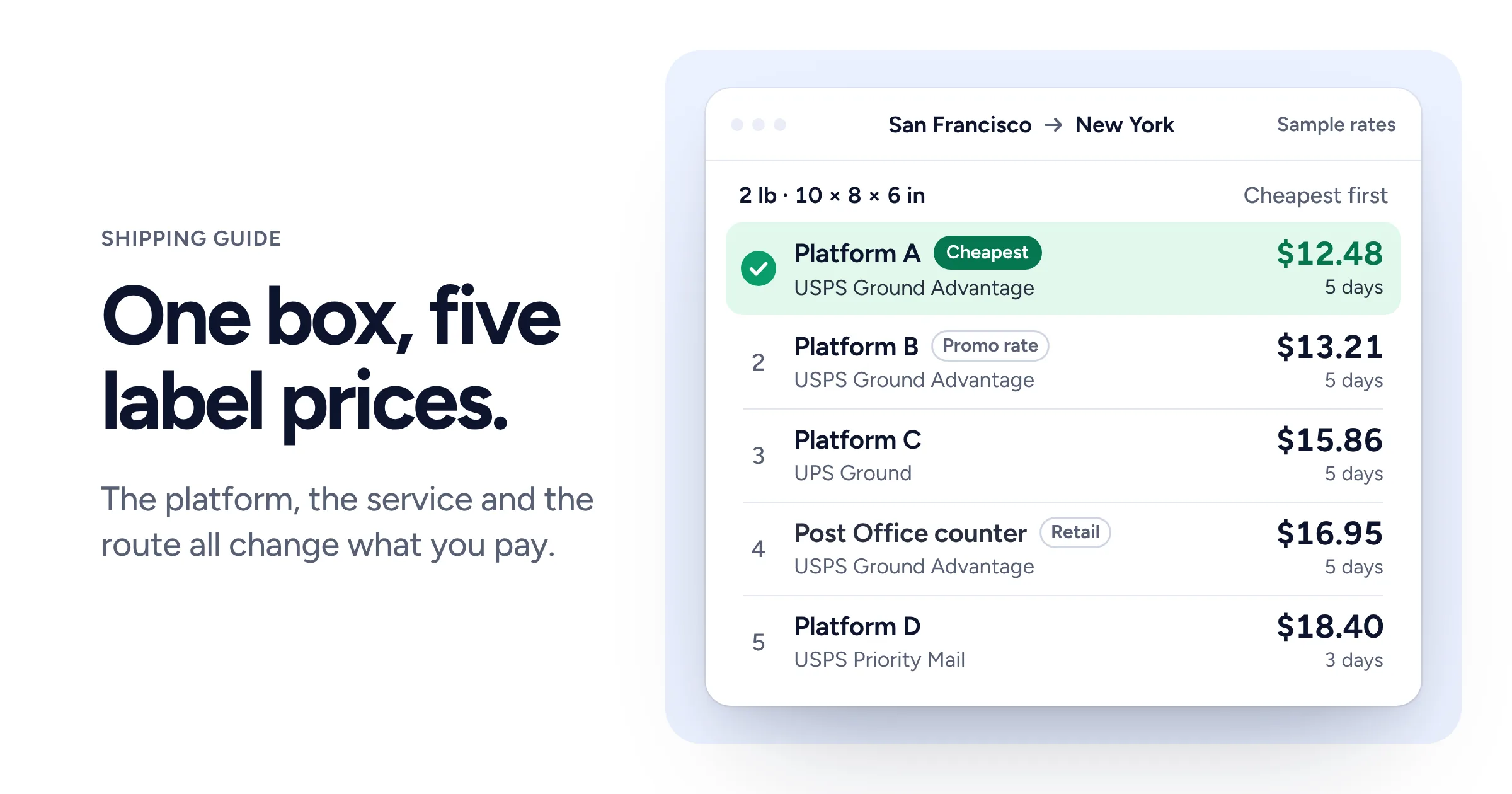
Price the same 2 lb box on three label platforms and you can get three different numbers, plus a fourth, higher one at the Post Office counter. None of them is a mistake: each price is built from a carrier rate, a discount, surcharges and fees that change with where you buy and what you pick. Once you know those pieces, finding the cheapest shipping labels becomes a quick habit instead of guesswork.
Why does the same shipping label cost different amounts?
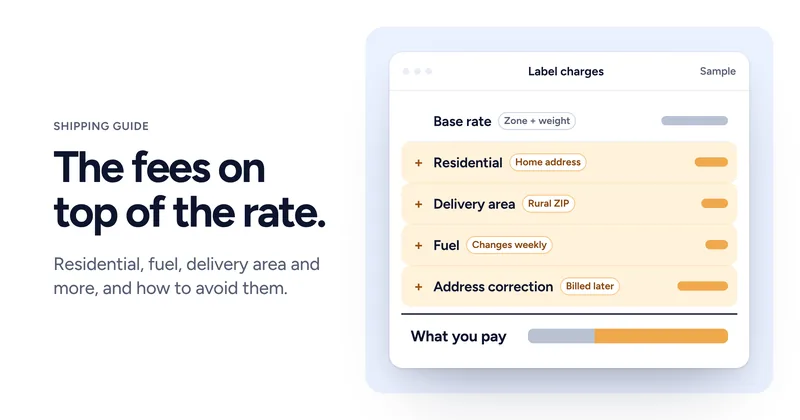
A shipping label price isn’t one number set by the carrier; it’s a stack of pieces. It starts with the carrier’s published rate, set by the zone (how far the package travels) and the billable weight: the actual weight or the dimensional weight (a weight based on the box’s size), whichever is greater. Then comes the discount, meaning the price list you qualify for plus any deals the platform has arranged. Surcharges go on top, such as residential delivery or fuel at UPS and FedEx, and some platforms add a subscription or a fee per label.
Label price = carrier rate (set by zone and billable weight) − discount + surcharges + platform fees
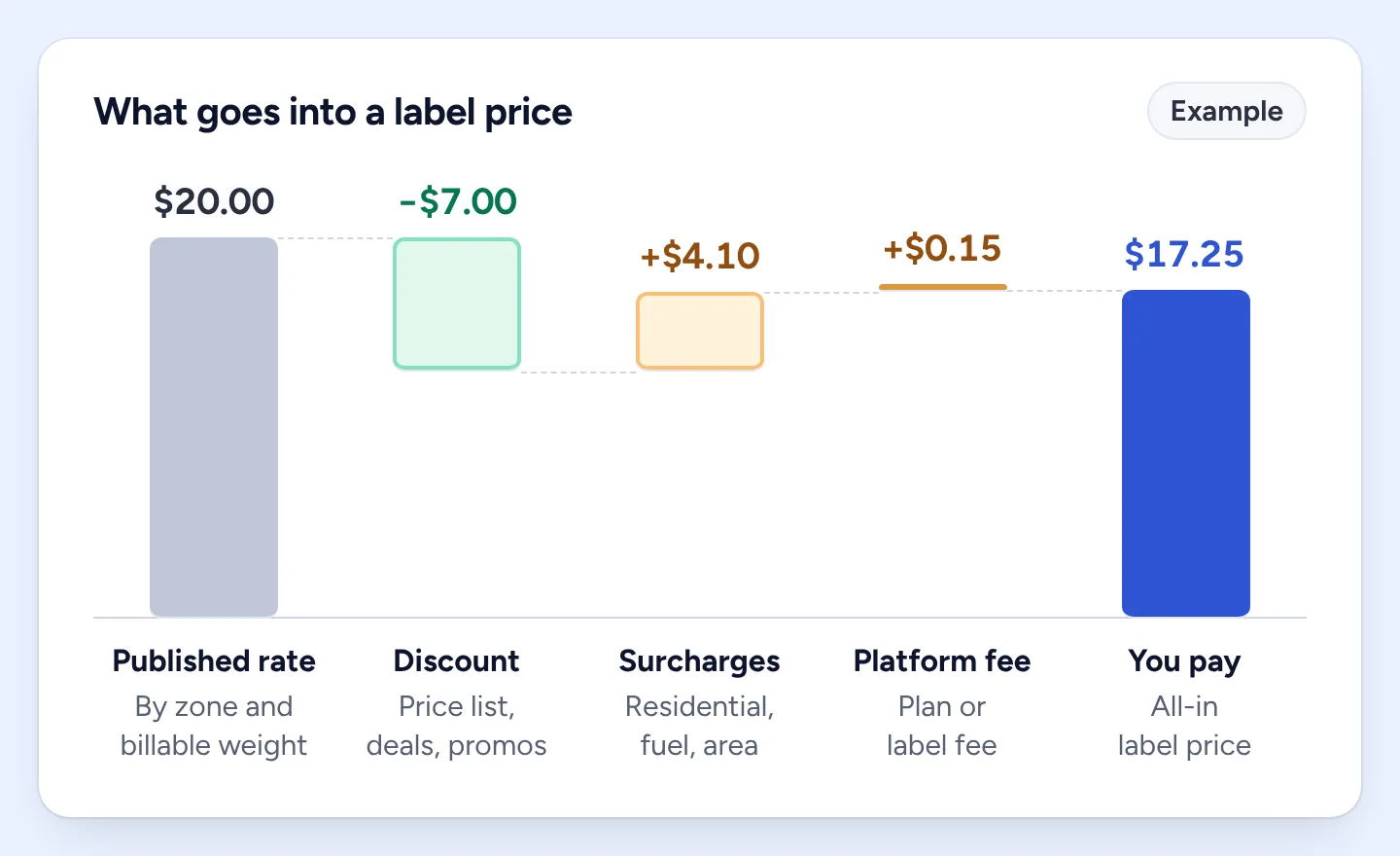
Change any layer and the total moves. That’s how two platforms selling the same carrier and service can end up a dollar or two apart.
Retail vs. commercial pricing, and why platforms differ
Every major carrier keeps more than one price list, and the one you pay depends mostly on how you buy the label.
USPS: Retail and Commercial prices
USPS publishes two sets of package prices in its price list, Notice 123. Retail prices are what you pay when you hand a package to a clerk at the Post Office counter. Commercial prices are lower, and they apply when you buy postage online, through USPS Click-N-Ship or a label platform that sells USPS postage.
You don’t need a contract or a minimum volume for USPS commercial rates: USPS says all Click-N-Ship users automatically get Commercial pricing on Priority Mail Express, Priority Mail and USPS Ground Advantage. Business accounts on Click-N-Ship also get the Business Rate Card, a lower price tier for Priority Mail and Ground Advantage packages under 20 lb. If you still buy labels at the counter, moving online is the simplest saving there is.
UPS and FedEx: retail, daily and account rates
UPS works the same way under different names. Its Retail Rates apply when you ship from a UPS retail location such as The UPS Store, or when you have no UPS account or scheduled pickup. Daily Rates, which are lower, apply to customers with a scheduled pickup or a UPS account that provides Daily Rates. FedEx publishes Retail Rates and Standard List Rates, and shippers with an account may get account-specific discounts off those rates.
Label platforms sit in between: many have their own agreements with UPS and FedEx and pass discounted rates on to sellers who don’t have a carrier contract.
Why platforms quote different prices for the same package
Quotes for the same package can differ from one platform to the next, for four reasons.
Negotiated rates. Platforms that ship large volumes can negotiate their own carrier rates. USPS’s July 2026 price change shows why that matters: since July 12, 2026, published Commercial Ground Advantage prices no longer step up by the ounce under 1 lb, so a 4 oz package costs the same as a 15.99 oz one going to the same zone. USPS said negotiated Ground Advantage rates aren’t affected, so a platform with its own agreement can still price light packages differently.
Promos. Platforms run promotions on a carrier, a service or for new accounts. While one lasts, it can make that platform the cheapest for a specific service and route.
Subscriptions and fees. Some platforms are free to use; others charge a monthly plan, a fee per label, or extra for certain carriers. Fees don’t show up in the rate, so spread them across your labels to compare fairly.
Do the subscription math
Divide a plan’s monthly price by the labels you buy each month. For example, a $29 plan at 200 labels a month adds about 15¢ per label ($29 ÷ 200 = $0.145). It only pays off if its rates beat your free option by more than that.
Carriers and services on offer. Not every platform offers every carrier, service or packaging option. If the cheapest service for a package isn’t on your platform’s list, you won’t see it there at all.
How the service, route and box size change the cheapest option
No carrier or service is cheapest for every package. The service you pick, the distance and the box itself decide the winner each time.
Ground Advantage, Priority Mail, UPS Ground or FedEx
The service usually moves the price more than the platform does, and each carrier adds different charges.
| Service | Delivery | Max weight | Fuel surcharge | Residential charge |
|---|---|---|---|---|
| USPS Ground Advantage | 2–5 days | 70 lb | None | None |
| USPS Priority Mail | 2–3 days | 70 lb | None | None |
| UPS Ground | 1–5 days | 150 lb | Yes, weekly | Yes |
| FedEx Ground | 1–5 days | 150 lb | Yes, weekly | Yes |
| FedEx Home Delivery | 1–5 days | 150 lb | Yes, weekly | Yes |
USPS doesn’t add fuel or residential surcharges, though it does charge nonstandard fees for long or large boxes. UPS and FedEx add fuel and residential charges to their ground rates, so a home delivery can cost well above the base rate. FedEx Home Delivery is FedEx’s ground service for residential addresses, and it delivers every day of the week, including weekends, in most areas. Our guide to carrier surcharges covers the ones that show up most.
Delivery times in the table are days within the contiguous US (business days, except FedEx Home Delivery, which also delivers on weekends), and they’re estimates, not promises: USPS notes that Priority Mail’s expected delivery date isn’t guaranteed. If your listing says 5–7 days, paying for Priority Mail on a package that Ground Advantage would deliver in time is an avoidable cost. If you promised 3 days, a cheaper label that arrives late isn’t a saving.
Route: the shipping zone
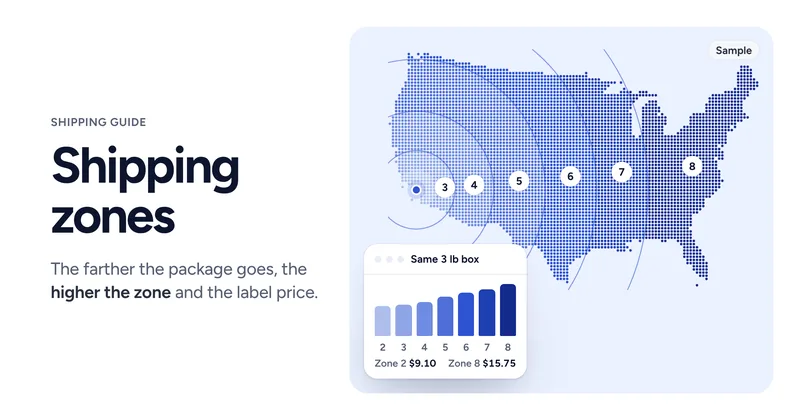
Carriers price by zone, a number that grows with the distance between the origin and destination ZIP codes. USPS uses Zones 1–9. A service that’s cheapest for a short trip can lose on a cross-country one, because each carrier’s prices climb at a different pace as the zone goes up. Our guide to shipping zones shows how to find yours.
Weight and size: billable weight
Carriers charge for the billable weight, the greater of the actual weight and the dimensional weight. FedEx divides the box’s cubic inches by 139 and rounds up to the next pound, and so does UPS at its Daily Rates (its Retail Rates use 166). Since July 12, 2026, USPS uses the same 139 divisor, but only for packages larger than 1 cubic foot (1,728 cubic inches).
Take a package that weighs 2 lb packed, in a 10 × 8 × 6 in box:
10 × 8 × 6 in = 480 cubic inches; 480 ÷ 139 = 3.45, rounded up to 4 lb billable at FedEx and at UPS Daily Rates
USPS bills the same box at its actual 2 lb, because 480 cubic inches is under 1 cubic foot. The full rules are in dimensional weight explained.
Trim the box, drop a pound
In the example above, shipping the item in a 9 × 7 × 5 in box (315 cubic inches) gives 315 ÷ 139 = 2.27, so 3 lb billable instead of 4 lb. A box that fits the product is often the quickest way to lower a quote.
Small, heavy packages: Flat Rate and cubic pricing
USPS has two ways to price small, heavy packages by size instead of weight. Priority Mail Flat Rate boxes cost the same up to 70 lb, wherever they go in the US. Cubic pricing, a Commercial-only option for packages up to 20 lb, charges by the box’s volume tier and the zone: up to 0.5 cubic foot for Priority Mail and 1 cubic foot for Ground Advantage. For a dense item going far, either one can undercut a weight-based rate; for a light item, it usually won’t.
Why shipping rates change from week to week
A quote is good for the day you buy the label. Rates move for three reasons.
Carriers change their price lists. USPS changed parcel prices several times in 2026: new prices in January, a time-limited 8% increase from April 26 to cover transportation costs, restructured Commercial Ground Advantage prices on July 12, and temporary holiday prices from October 4. Both temporary changes run until January 17, 2027. UPS and FedEx set new rates each year; FedEx’s 2026 list rates took effect January 5, 2026.
Surcharges float. UPS and FedEx adjust their fuel surcharges every week, based on the national average diesel price for ground services and the jet fuel price for air services. They also add demand surcharges in busy periods such as the holidays. USPS doesn’t add a separate fuel surcharge to its parcel services; its temporary increases are built into the rates instead.
Platform deals come and go. Promos start and end, and platforms renegotiate their carrier agreements. The platform that was cheapest for your usual package last month may not be this month.
How to compare shipping rates and find the cheapest shipping labels
A fair comparison takes a minute once it’s a habit. Use the same four steps for every package.
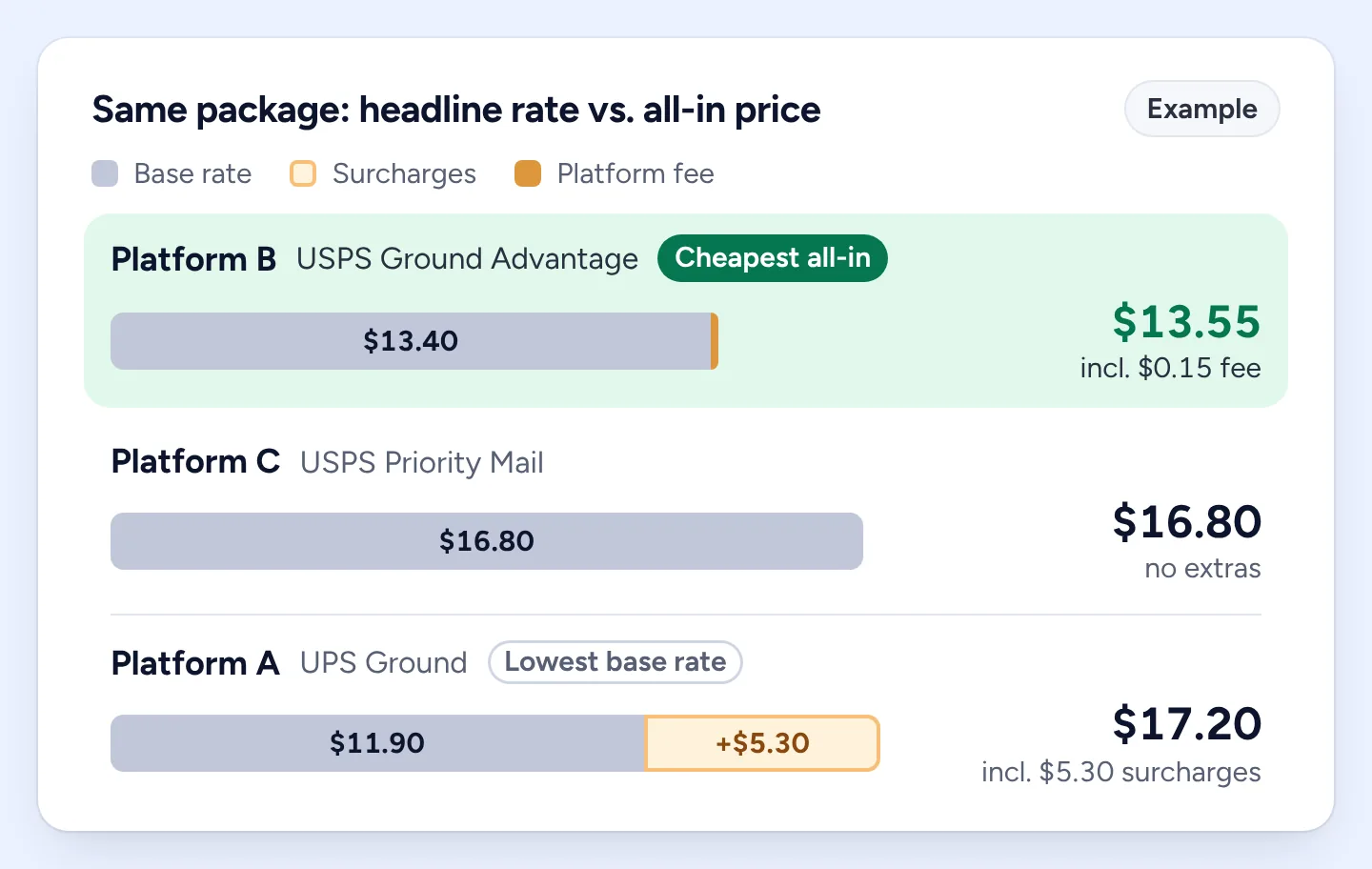
- Use identical package details. Enter the same ZIP codes, weight and real box dimensions on every platform, and mark whether the address is a home or a business, because UPS and FedEx price those differently.
- Compare the all-in price. Make sure each quote includes the same things: surcharges such as residential delivery and fuel, the platform’s fees, and add-ons you need, like a signature.
- Match the delivery speed you promised. Drop the services that can’t meet your promise, then pick the cheapest of the rest.
- Buy where it’s cheapest today. Take the label from whichever platform wins for this package, even if it isn’t your usual one, and check again for the next order.
Wrong details cost you later
If the weight or dimensions you enter are lower than what the carrier measures, the carrier can bill an adjustment after the package ships, which wipes out the saving. Weigh and measure every package, and check your invoices for corrections. Our guide to shipping audits and refunds explains how to spot them.
Compare 30+ label platforms at once
Doing this by hand for every order gets slow. ShipSqueeze checks 30+ label platforms for every order, including Shippo, ShipStation, Pirate Ship, ShippingEasy, Easyship, Stamps.com, EasyPost, Ordoro and USPS Click-N-Ship. Across USPS, UPS, FedEx, DHL and regional carriers, it checks the platform, carrier, service and any promo, and shows you where the package ships cheapest today.
Orders come in from Shopify, WooCommerce, Amazon, eBay or Etsy with weight and size, or you can enter a package by hand. You click through to the winning platform and buy the label there, paying the platform directly. Already use one platform? Keep it: ShipSqueeze tells you when another is cheaper for a specific shipment. Sellers save $1.50+ per label on average. See how it works for ecommerce sellers, or start on the Free plan, no credit card required.
Common questions about shipping label prices
Are shipping labels cheaper online than at the Post Office?
Yes, for USPS. The counter charges Retail prices, while labels bought online get Commercial prices or lower. UPS is similar: a UPS retail location such as The UPS Store charges Retail Rates.
Do I need high volume to get commercial rates?
Not for USPS. Labels bought online get Commercial prices with no contract or minimum. Rates below Commercial come from programs such as the Business Rate Card for Click-N-Ship business accounts, or from volume, either yours or that of the platform you buy through.
Why did my carrier charge more than the label price?
Usually because the carrier measured the package as heavier or larger than the label said, or because a charge such as an address correction applied after it shipped. Not every adjustment is correct, so review them.
Is the cheapest label always the best choice?
Only if it arrives when you promised and includes what you need. Compare what each service bundles: USPS Ground Advantage and Priority Mail, for example, include tracking and some insurance.
Sources
- USPS: Online Shipping with Click-N-Ship (Commercial pricing, Business Rate Card)
- USPS Postal Explorer: Notice 123, Price List
- USPS: USPS Ground Advantage for Business
- USPS FAQ: What is Priority Mail?
- USPS FAQ: What are the Zone Charts? (zones 1 through 9)
- USPS Postal Explorer: DMM 223, Priority Mail commercial prices and eligibility (cubic pricing)
- USPS Newsroom: Competitive price changes for July 2026
- USPS Newsroom: Temporary price change for the 2026 holiday shipping season
- UPS: Shipping dimensions and weight
- FedEx: Weekly fuel surcharge changes
- FedEx: FedEx Home Delivery
- FedEx: FedEx Ground