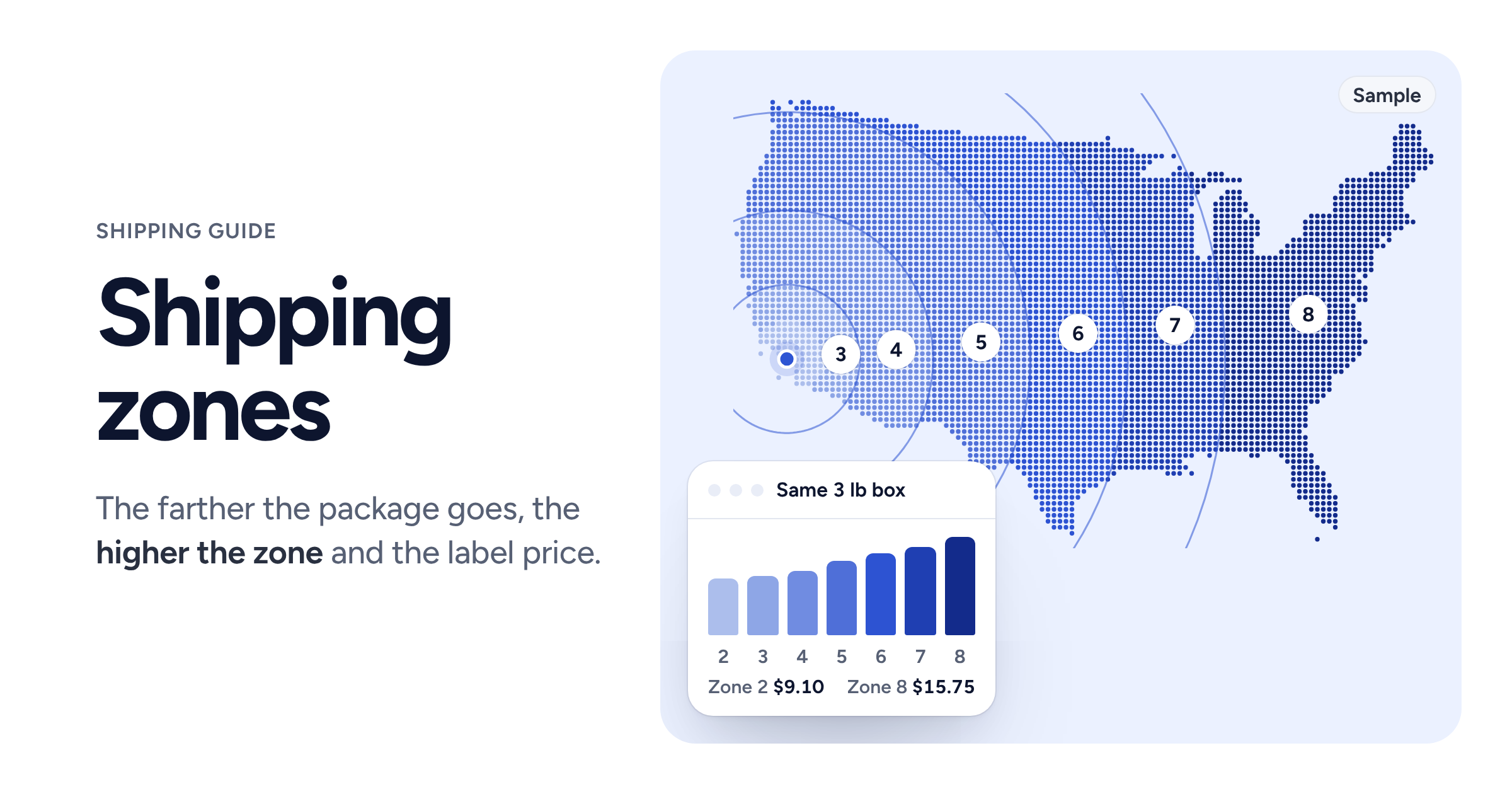
Ship the same 3 lb box to a customer in the next county and to one across the country, and the second label costs more, sometimes a lot more. The reason is shipping zones: for most services, carriers price each parcel by the distance band between your ZIP code and your customer’s. This guide explains how USPS, UPS and FedEx zones work, how to look up the zone for any order, and the practical ways to pay less for long-distance shipments.
What are shipping zones?
A shipping zone is a number that stands for how far a package travels. Carriers draw distance bands around your origin ZIP code, and every destination falls into one of them. Zone 1 or 2 is close to you; Zone 8 is the far side of the country.
Zones exist because distance drives a carrier’s costs: more miles on trucks and planes, more sorting facilities, more handoffs. Rather than charge by the mile, carriers group destinations into a handful of bands and publish one price per band in their rate charts.
USPS works out zones from the center point of each 3-digit ZIP code area (all ZIP codes that share the same first three digits). So, apart from a few listed exceptions, every address in 900xx (Los Angeles) has the same zone to every address in 100xx (Manhattan), whatever the exact streets.
The distance bands USPS uses look like this:
| Zone | Distance (USPS) | Zone number used by |
|---|---|---|
| Zone 1 | Up to 50 miles | USPS |
| Zone 2 | 51–150 miles | USPS, UPS, FedEx |
| Zone 3 | 151–300 miles | USPS, UPS, FedEx |
| Zone 4 | 301–600 miles | USPS, UPS, FedEx |
| Zone 5 | 601–1,000 miles | USPS, UPS, FedEx |
| Zone 6 | 1,001–1,400 miles | USPS, UPS, FedEx |
| Zone 7 | 1,401–1,800 miles | USPS, UPS, FedEx |
| Zone 8 | 1,801 miles and over | USPS, UPS, FedEx |
| Zone 9 | Freely Associated States | USPS |
Zone 9 is the odd one out: it isn’t about distance at all. The next section explains it.
USPS zones vs. UPS and FedEx zones
USPS zones
USPS prices its main parcel services, Priority Mail and USPS Ground Advantage, by weight and zone. Zone 9 is a special case: the Domestic Mail Manual reserves it for the Freely Associated States, the Republic of Palau, the Federated States of Micronesia and the Republic of the Marshall Islands, which USPS treats as domestic destinations.
Some online guides say Zone 9 covers Hawaii, Alaska or Puerto Rico. At USPS, it doesn’t. Those destinations get a zone by distance like any other ZIP code, and because they’re so far from most of the mainland, they usually land in the higher zones.
UPS zones
UPS numbers its zones within the contiguous US from 2 to 8; there’s no Zone 1. Alaska, Hawaii and Puerto Rico have their own zones and rate tables.
A UPS zone chart lists a separate code for each service. On a route that is Zone 5 for UPS Ground, for example, the chart might show 005 for Ground and 205 for 2nd Day Air. The last digit is the distance zone, and the leading digits tell you which rate table to use.
FedEx zones
FedEx also uses Zones 2 to 8 for the contiguous US. Its zone guides put Zone 2 at 0–150 miles, and Zones 3 to 8 match the USPS bands in the table above. Like UPS, FedEx gives Alaska, Hawaii and Puerto Rico separate zone numbers. FedEx Ground Economy, for example, uses Zone 9 for Hawaii, so a FedEx Zone 9 and a USPS Zone 9 are different places.
The upshot: USPS and FedEx publish nearly the same mileage bands, and UPS uses the same Zone 2–8 numbering. Each carrier draws its own chart, though, so always check the chart for the carrier you’re shipping with.
How to look up a shipping zone with a zone chart
A zone chart is a table for one origin: it lists destination ZIP code ranges and the zone for each. Every carrier has a free one.
- USPS: open the Domestic Zone Chart in the USPS Postage Price Calculator and enter the first three digits of your origin ZIP code to get your full chart. To check a single order, use the ZIP code pair tab and enter both ZIP codes.
- UPS: on the UPS Daily Rates and Zone Charts page, enter your origin ZIP code and select Download to get your zone chart. Each row covers a range of destination ZIP codes.
- FedEx: use the zone locator in the FedEx rate tools, starting from your origin ZIP code.
Look up your top ten destination states once and note the zones. It takes a few minutes and tells you how much of your volume rides in Zones 7 and 8, which is the number that matters for the strategies below. If you ship from more than one location, you need a separate chart for each origin.
How zone and weight set your shipping cost
A carrier’s rate chart is a grid: weight down the side, zones across the top. Your base price is the cell where the two meet.
Base price = rate chart cell for (billable weight, zone)
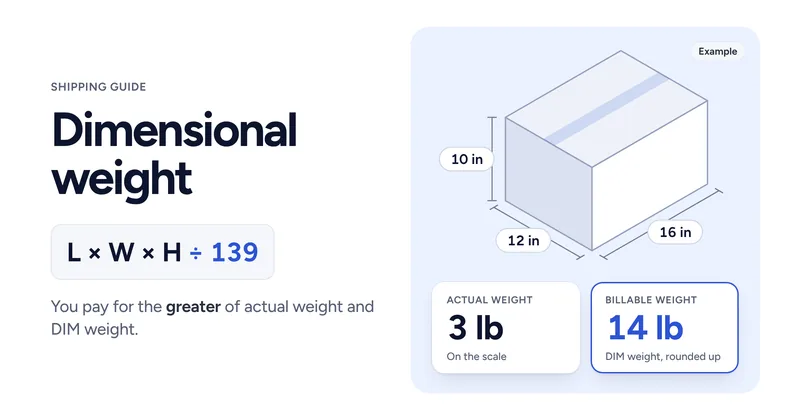
Billable weight is the greater of the package’s actual weight and its dimensional weight, a weight the carrier calculates from the box’s size (at USPS, only for boxes over 1 cubic foot). A light, bulky box can be billed as if it weighed several times more, which is why the size of the box matters. Our guide to dimensional weight shows how to calculate it.
Here’s what zone alone does to one package, with everything else held the same:
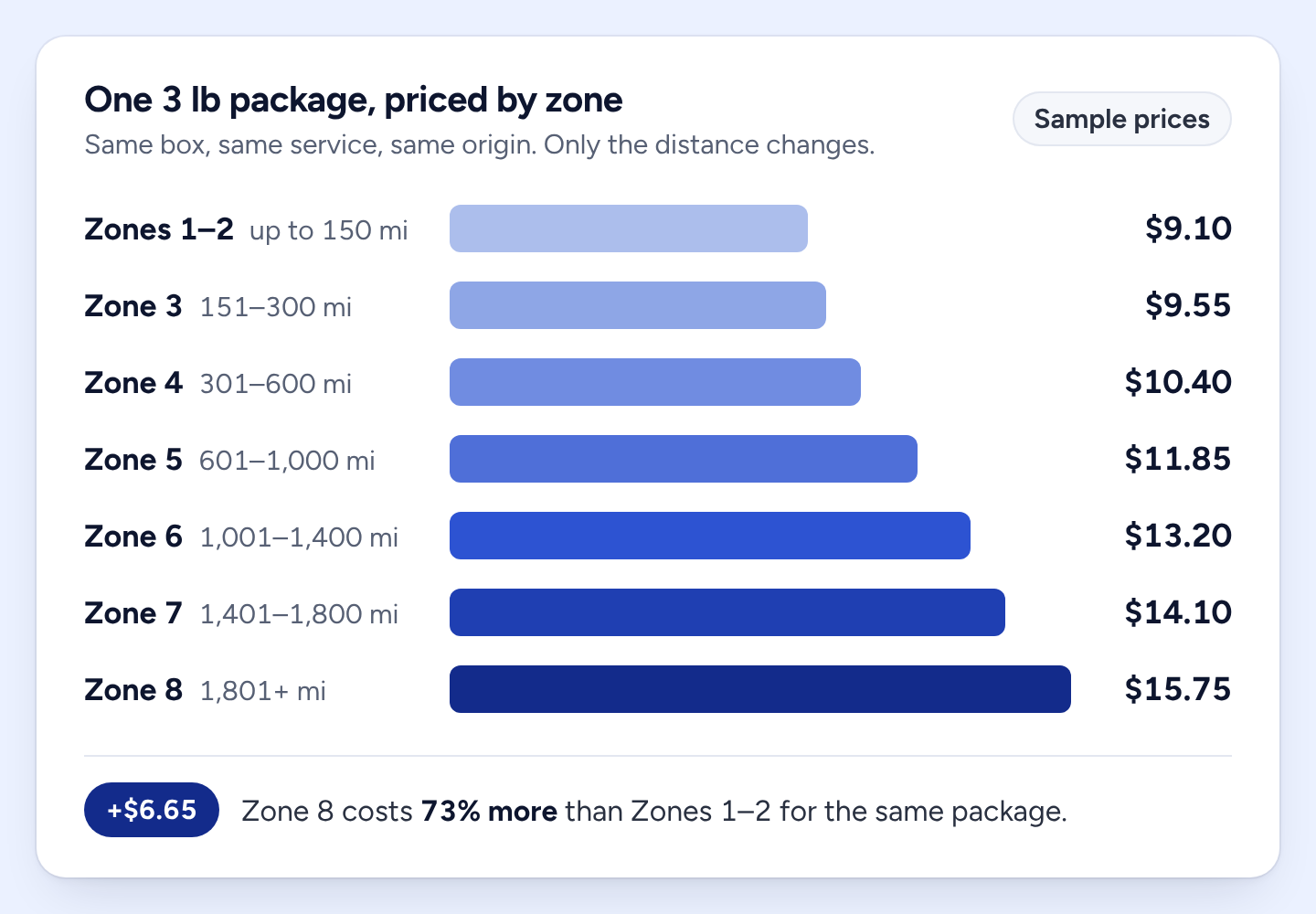
Weight and zone compound each other. In carrier rate charts, each extra pound usually adds more in a high zone than in a low one, so a box that gains billable pounds from dimensional weight costs the most when it goes the farthest. That’s also why the cheapest label for the same box can change from one order to the next.
Peak-season increases depend on zone too
Even temporary price increases can be tiered by zone. As of October 2026, USPS’s temporary holiday prices (from October 4, 2026 until January 17, 2027) add $0.50 to a retail Priority Mail package up to 3 lb in Zones 1–4, and $1.00 in Zones 5–9. Commercial prices go up for the same period too. See our guide to carrier surcharges for the peak-season fees UPS and FedEx add.
How to lower shipping costs to far zones
Ship from closer to your customers
The most direct fix is to shorten the trip. A second warehouse, or a third-party logistics provider (3PL) that stores your stock and ships it for you from several locations, puts more of your customers in low zones.
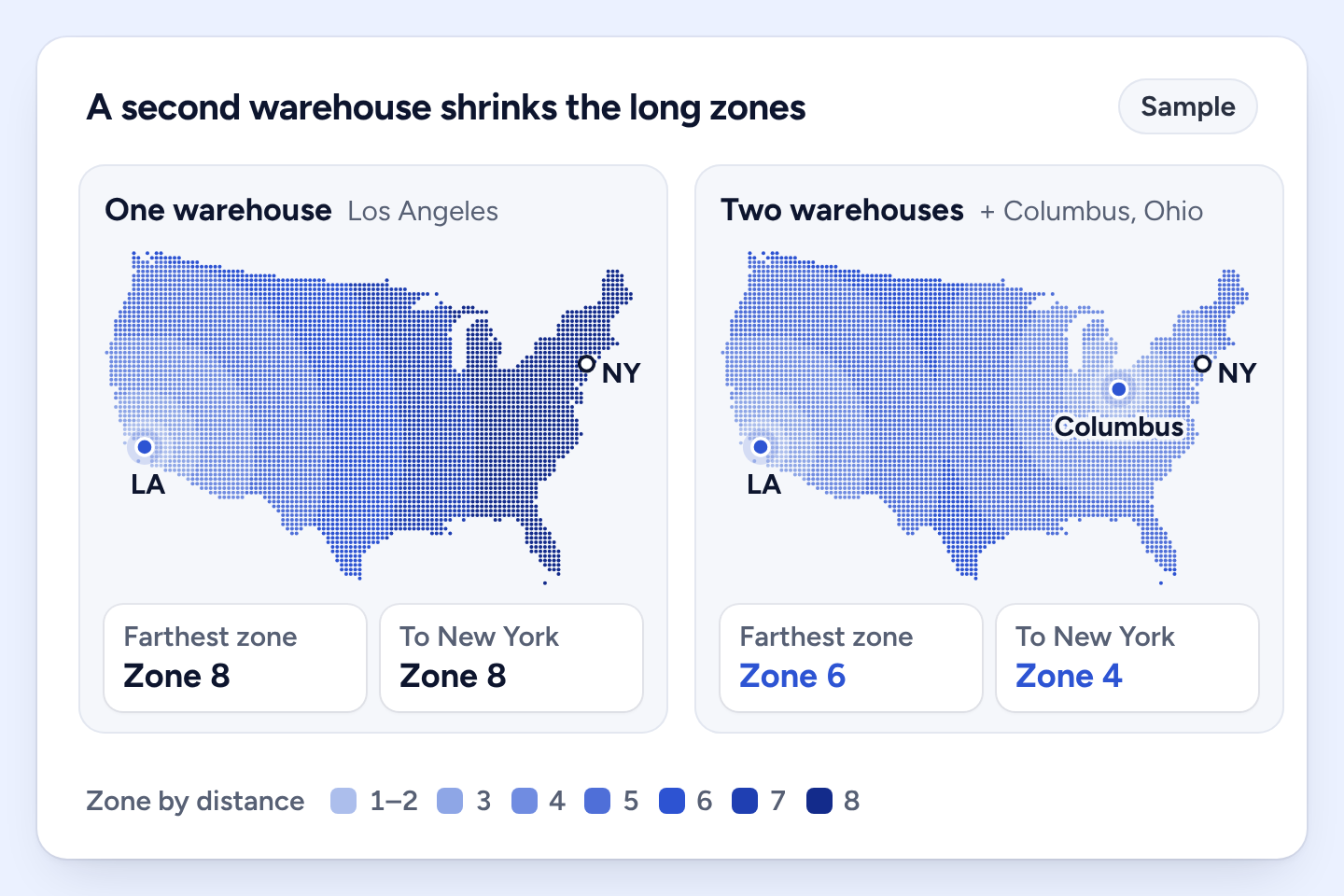
Take a store in Los Angeles that ships 3 lb orders nationwide and adds a second warehouse in Columbus, Ohio. Each order ships from whichever location is closer:
| Destination | From Los Angeles | From Columbus | Price, one warehouse | Price, two warehouses |
|---|---|---|---|---|
| Phoenix | Zone 4 | Zone 7 | $10.40 | $10.40 |
| Denver | Zone 5 | Zone 6 | $11.85 | $11.85 |
| Dallas | Zone 6 | Zone 5 | $13.20 | $11.85 |
| Atlanta | Zone 8 | Zone 4 | $15.75 | $10.40 |
| New York | Zone 8 | Zone 4 | $15.75 | $10.40 |
| Total, five orders | $66.95 | $54.90 |
Phoenix and Denver don’t change, Dallas drops one zone, and Atlanta and New York drop from Zone 8 to Zone 4. Now scale that up. If 400 of your 1,000 monthly orders go to places like Atlanta, New York and Washington, D.C., and each drops from Zone 8 to Zone 4 at these sample prices:
400 orders × ($15.75 − $10.40) = 400 × $5.35 = $2,140 a month
Weigh that against what the second location costs: storage, receiving fees, a split inventory that’s harder to keep in stock, and any 3PL fees. Your order data tells you whether the far zones carry enough volume to pay for it.
Pick the cheapest carrier for each zone
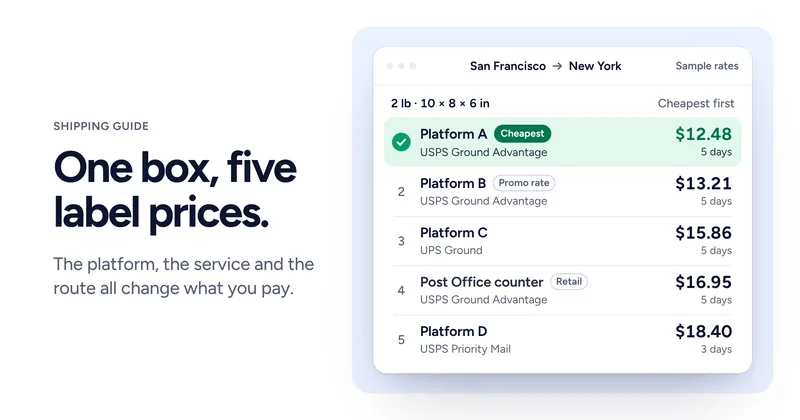
Each carrier’s rate chart climbs at its own pace from zone to zone, so the service that wins on a Zone 2 order may not win on a Zone 8 one, even for the same box. Regional carriers deliver only within part of the country, which makes them worth checking for nearby orders. The platform you buy the label on changes the price as well, as our guide to why label prices differ explains.
Use prices that don’t depend on distance
Priority Mail Flat Rate boxes and envelopes ship to any state for the same price, up to 70 lb, so zone doesn’t matter. Other Priority Mail prices depend on the zone. Media Mail prices also ignore zone, but that service is only for eligible items such as books and recorded media.
Where Flat Rate pays off
Flat Rate tends to win when a dense, heavy item that fits the box is going to a far zone. For a light item going a short distance, a zoned price is usually lower. Compare both before you pick a box.
Zone skipping for high volume
Zone skipping means trucking many parcels together to a carrier facility near your customers, then handing them over there so they travel only the last stretch in the carrier’s network. USPS supports this with Parcel Select destination entry: parcels dropped at the USPS processing plant (sectional center facility), hub or local delivery post office that serves the address are priced by weight only, not zone, as long as they’re part of a mailing of at least 50 Parcel Select pieces.
The freight to get there isn’t free, and you need enough parcels heading to one region to fill a truck or a pallet. Consolidators and 3PLs offer it by combining parcels from many shippers, which is how smaller stores can get access.
Find the cheapest label for every order
Zones are a big reason the cheapest label changes from order to order. ShipSqueeze checks 30+ label platforms for every order, across USPS, UPS, FedEx, DHL and regional carriers, and shows you where that package ships cheapest today. Orders come in from Shopify, WooCommerce, Amazon, eBay or Etsy with origin, destination, weight and size, so distance is part of every comparison.
If you ship from more than one warehouse, add each origin ZIP code so every order is priced from the location it ships from. You click through and buy the label on the winning platform. See how it works for online stores, or start on the Free plan with no credit card required.
Common questions about shipping zones
Do shipping zones affect delivery time?
For ground services, yes. UPS Ground, for instance, takes 1–5 business days depending on how far the package goes, and UPS publishes ground time-in-transit maps based on your origin ZIP code. Check the transit time to your Zone 7 and 8 customers before you promise delivery dates.
Do shipping zones apply to international packages?
Not the domestic ones. USPS prices international mail by country price group, a number assigned to each destination country, so check the carrier’s international price list for those shipments.
Do shipping zones change?
The mileage bands stay the same, but USPS revises its zone charts quarterly. Your zones also change whenever you ship from a new location, so pull a fresh chart for each origin ZIP code.
Do zones apply to return labels?
Yes. USPS prices return labels by the package’s weight and the zone between where your customer mails it and your return address, so a return from across the country costs more than one from nearby. That adds up if you offer free returns; our guide to cutting return shipping costs shows how to keep it down.
Sources
- USPS: What are the zone charts and how can I obtain one?
- USPS Domestic Mail Manual 608: Postal information and resources (Zone 9)
- USPS Office of Inspector General: Management of Postal Zones (zone distances)
- USPS: Priority Mail (Flat Rate pricing)
- USPS Newsroom: Temporary price change for the 2026 holiday shipping season
- USPS International Mail Manual: Country price groups and weight limits
- UPS: Daily Rates and Zone Charts
- FedEx Ground Economy zones and rates, 2026 (zone distances; Alaska, Hawaii and Puerto Rico zones; zone lookup)